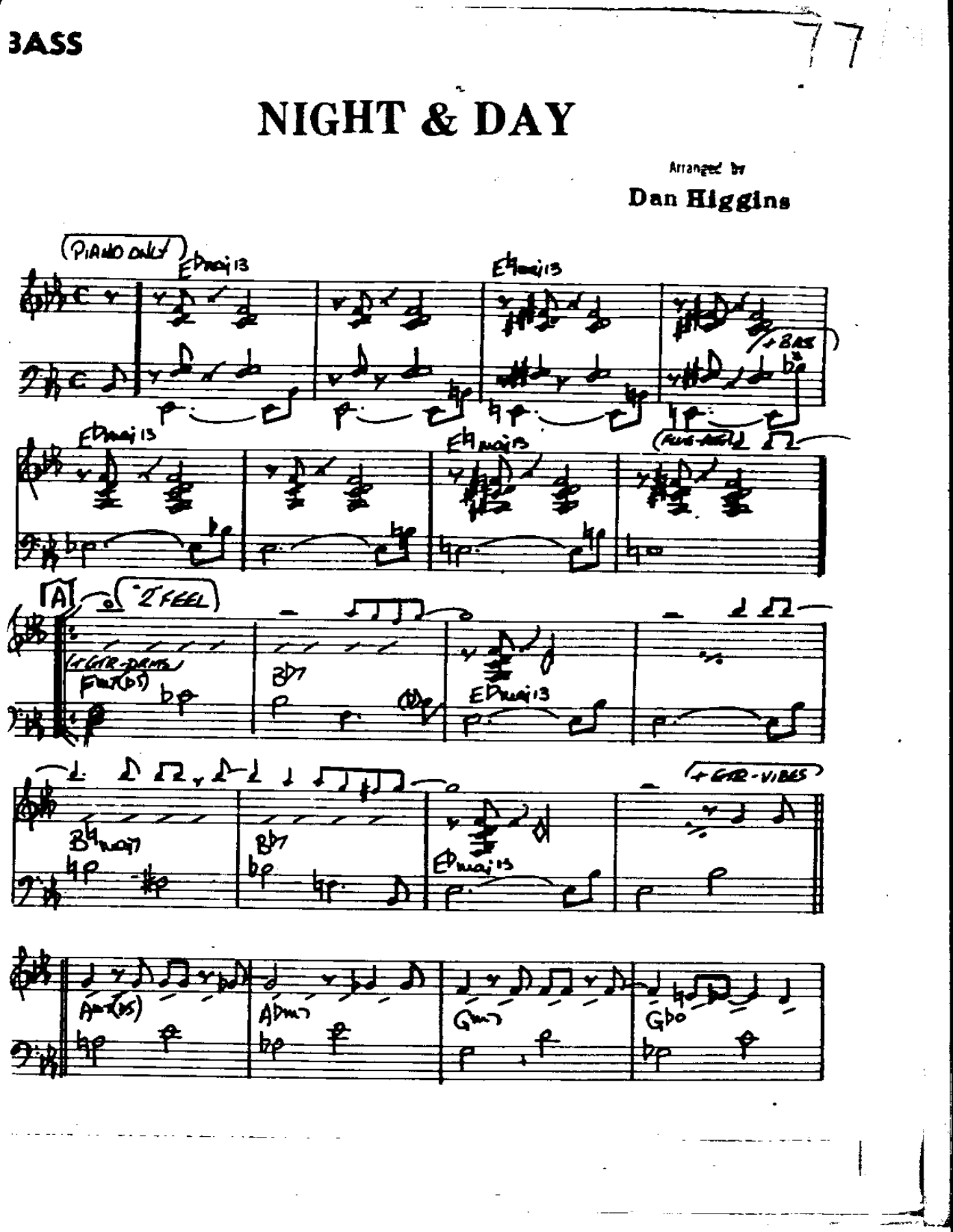
Night & Day-Bass (comp. Cole Porter) sheet music preview

Night & Day-Bass (comp. Cole Porter)

Composed by Cole Porter

Arranged by Dan Higgins

  • Ensemble: Small Ensemble
  • Style: Jazz Standard
  • Pages: 4
  • Instruments (1): Bass
  • Difficulty: easy
  • Content: Individual Parts
  • Format: PDF Download (Instant)
  • Price: $12.99

Cole Porter's timeless composition, "Night and Day," emerged in 1932 for the Broadway musical *Gay Divorce*, quickly cementing its status as a quintessential American Songbook standard. Its sophisticated AABA form, distinctive minor-key verse leading into a major-key chorus, and the iconic, persistent four-note ostinato in the melody have captivated audiences and musicians for nearly a century. Immortalized by vocalists like Frank Sinatra, Fred Astaire (who introduced it), and Billie Holiday, and instrumentalists across jazz, pop, and classical genres, "Night and Day" remains a cornerstone of the jazz repertoire, celebrated for its lyrical depth and harmonic richness. It embodies the elegance and melodic ingenuity characteristic of the Golden Age of Broadway, seamlessly transitioning into the jazz idiom through countless interpretations. This particular arrangement of "Night & Day-Bass" presents a compelling interpretation of the classic, designed specifically for a small ensemble setting. It establishes a medium swing feel, maintaining a sophisticated yet approachable tempo that allows for both melodic clarity and rhythmic drive. The arrangement is primarily set in the key of C minor, transitioning expertly to C major for the iconic chorus, capturing the original's emotional arc from introspective yearning to ardent declaration. The overall mood is one of elegant romance tempered with a subtle, swinging energy, making it suitable for both intimate club performances and more formal concert settings. The arrangement's brevity (4 pages) suggests a concise yet impactful rendition, focusing on the core melodic and harmonic elements. The Unknown Arranger's approach to "Night & Day-Bass" emphasizes clarity and interplay within the small ensemble. While the specific instrumentation isn't detailed, the "Bass" in the title strongly suggests a prominent role for the bass instrument, likely carrying the melody or a significant counter-melody at various points, or perhaps even being the featured solo voice. This treatment likely foregrounds the bass's melodic capabilities beyond its traditional rhythmic and harmonic support. Expect thoughtful voicings that allow each instrument to contribute distinctly, avoiding dense textures in favor of transparent, interactive lines. The arrangement will likely feature a blend of ensemble sections and opportunities for improvisation, providing a rewarding challenge for musicians accustomed to nuanced small-group dynamics. Performing this arrangement offers a rewarding experience for intermediate to advanced small ensembles. The primary technical challenge lies in maintaining the consistent medium swing feel while navigating the harmonic shifts and melodic contours, particularly if the bass is featured melodically. Articulation and dynamic control will be crucial to convey the piece's inherent elegance and emotional depth. Solo sections, if present, will require improvisational fluency over the standard's well-known changes. The arrangement's strength lies in its ability to highlight individual musicianship within a cohesive group sound, making it an excellent choice for college jazz combos, advanced high school ensembles, or professional small groups seeking a fresh yet respectful take on a beloved standard. Conductors should emphasize a relaxed, yet precise medium swing feel throughout, ensuring the rhythmic pulse is steady without being rigid. Articulation is paramount; encourage a light, detached approach for swing eighths, with legato phrasing for sustained melodic lines, especially in the minor sections. Pay close attention to dynamic contrasts to enhance the emotional journey from the verse's introspection to the chorus's warmth. If the bass is featured melodically, ensure it has sufficient presence without overpowering the ensemble. Rehearsal should focus on harmonic clarity during key changes and the seamless integration of any improvised solos within the ensemble's texture. No special techniques like plungers or falls are explicitly indicated, suggesting a focus on clean, classic jazz articulation. Q: What instruments or parts are included in this arrangement? A: This arrangement is titled "Night & Day-Bass," strongly indicating a prominent role for the bass instrument, likely as a melodic feature or solo voice, within a small ensemble context. Specific instrumentation beyond the bass would be determined by the arranger's score. Q: What is the difficulty level of this arrangement? A: This arrangement is suitable for intermediate to advanced small ensembles, including college jazz combos, advanced high school groups, or professional small groups. It requires solid rhythmic precision, harmonic awareness, and potential improvisational skill. Q: What is the musical style and historical context of "Night & Day-Bass"? A: This is a jazz standard arrangement of Cole Porter's "Night and Day," composed in 1932. It embodies the sophisticated, elegant style of the Great American Songbook, interpreted with a medium swing jazz feel. Q: What makes this arrangement unique compared to other versions of "Night and Day"? A: The "Bass" in the title suggests a distinctive focus on the bass instrument, potentially featuring it melodically or as a primary solo voice, offering a fresh perspective on this classic standard within a small ensemble setting. Q: What is the typical performance duration or tempo for this arrangement? A: Given its 4-page length and medium swing feel, a typical performance duration would likely be between 3 to 5 minutes, allowing for ensemble statements and potential solo sections at a comfortable, grooving tempo.

Questions and answers

What is included in the Night & Day-Bass (comp. Cole Porter) PDF?
The verified current file contains individual parts across 4 pages.
How many instruments or parts are listed for Night & Day-Bass (comp. Cole Porter)?
The verified instrumentation list contains 1 entries for this Small Ensemble arrangement.
Who is credited for Night & Day-Bass (comp. Cole Porter)?
Composer: Cole Porter. Arranger: Dan Higgins.
What difficulty is listed for Night & Day-Bass (comp. Cole Porter)?
The verified difficulty level is easy.
What style is listed for Night & Day-Bass (comp. Cole Porter)?
The catalog lists the style as Jazz Standard.
Can I preview Night & Day-Bass (comp. Cole Porter) before buying?
Yes. The product page provides a preview generated from the current PDF file.
How is Night & Day-Bass (comp. Cole Porter) delivered?
After successful payment, the digital PDF is made available for download. The displayed price is $12.99.

Musicians Also Search For

Night & Day-Bass Dan Higgins PDFNight & Day-Bass Dan Higgins sheet musicNight & Day-Bass arranged by Dan HigginsDan Higgins small ensemble chartsDan Higgins jazz arrangements PDFNight & Day-Bass Cole Porter sheet musicNight & Day-Bass Cole Porter small ensemble arrangementsCole Porter small ensemble chartsNight & Day-Bass small ensemble arrangementsNight & Day-Bass small ensemble PDF downloadNight & Day-Bass jazz sheet musicsmall ensemble sheet music downloadNight & Day-Bass individual parts downloadNight & Day-Bass sheet music PDFNight & Day-Bass Jazz Standard chartsJazz Standard small ensemble arrangementsbuy Night & Day-Bass sheet musicdownload Night & Day-Bass PDFNight & Day-Bass jazz chartsbest Dan Higgins small ensemble arrangementsCole Porter arranged by Dan HigginsNight & Day-Bass printable sheet musicsmall ensemble repertoire PDF

All arrangements by Dan Higgins All Cole Porter sheet music