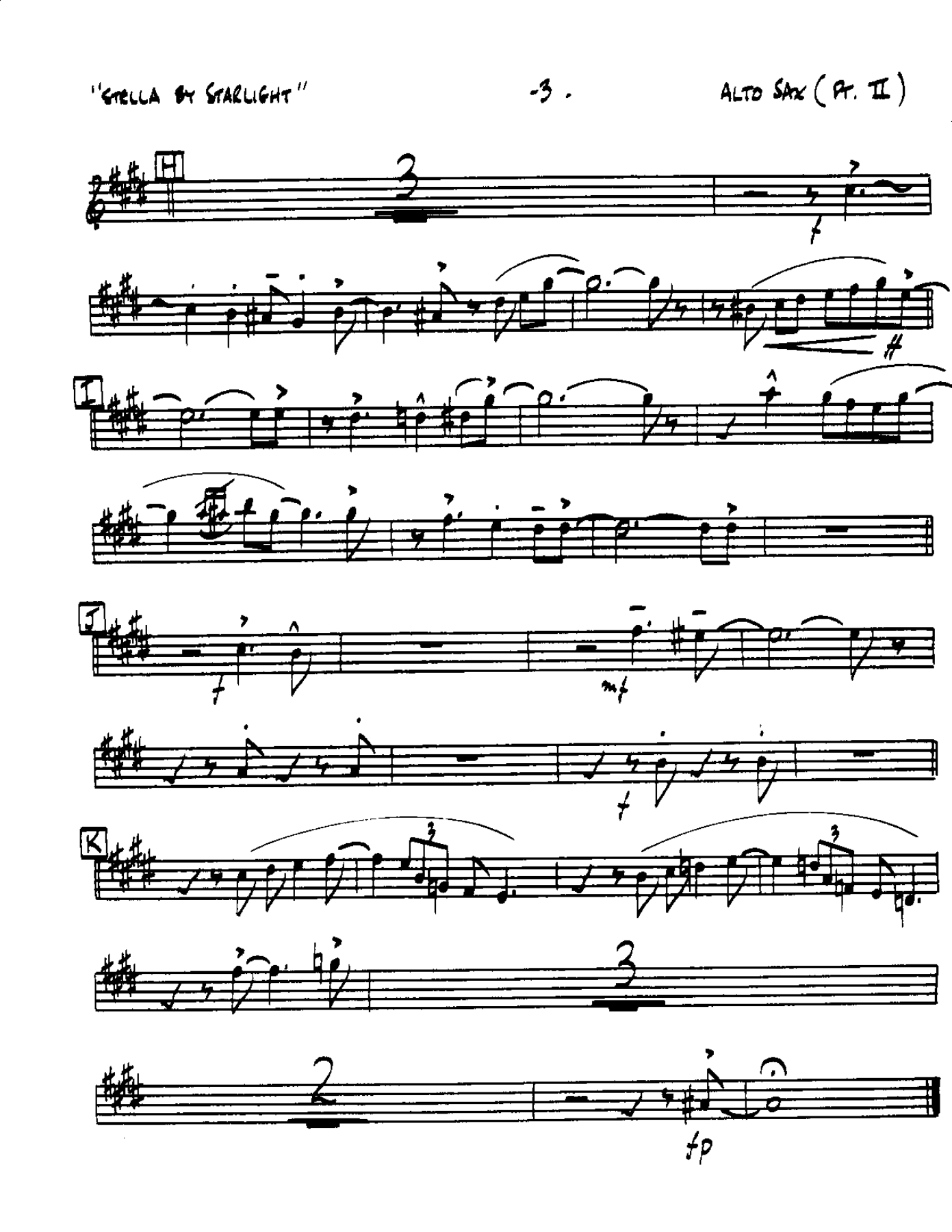
Stella by Starlight-Alto (comp. Victor Young)
Composed by Victor Young
Arranged by Unknown Arranger
- Ensemble: Small Ensemble
- Style: Jazz Standard
- Pages: 3
- Difficulty: easy
- Content: Sheet Music
- Format: PDF Download (Instant)
- Price: $12.99
Victor Young's "Stella by Starlight," originally composed in 1944 for the film *The Uninvited*, stands as a cornerstone of the jazz standard repertoire. Its hauntingly beautiful melody and sophisticated harmonic progression quickly captivated musicians, transcending its cinematic origins to become an indispensable vehicle for improvisation and melodic reinterpretation. The piece gained widespread jazz prominence through iconic recordings by artists such as Charlie Parker, Miles Davis, Stan Getz, and Chet Baker, each offering their unique perspective on its intricate structure. It represents the rich harmonic language and melodic inventiveness characteristic of the mid-20th-century American Songbook tradition, serving as a bridge between classical romanticism and the burgeoning bebop era. Its enduring appeal lies in its inherent lyricism and the harmonic depth that encourages endless exploration, making it a favorite for both seasoned improvisers and developing musicians. This particular arrangement for small ensemble presents "Stella by Starlight" in the key of Bb Major, maintaining a sophisticated medium swing feel (approximately 120-130 bpm). The arrangement thoughtfully preserves the original's melancholic yet hopeful mood, translating its emotional depth through carefully crafted voicings. The "Unknown Arranger" demonstrates a clear understanding of the standard's core appeal, focusing on clarity and musicality. The opening statement of the melody is typically carried by the alto saxophone, allowing its expressive timbre to introduce the iconic theme. Subsequent sections might feature the melody passed between other ensemble members, or a harmonized soli section that builds on the original's rich chord changes. The arrangement emphasizes a balance between ensemble cohesion and individual expression, providing a solid harmonic and rhythmic foundation for improvisation. The arranger's approach to "Stella by Starlight" is characterized by its elegant simplicity and respect for the source material, avoiding overly complex reharmonizations or rhythmic alterations that might obscure the original's charm. While specific voicings are not explicitly detailed without the score, one can expect well-balanced harmonies that support the melody without overpowering it, typical of small ensemble jazz writing. The arrangement likely features a dedicated solo section, offering ample space for an improviser—often the alto saxophone—to explore the tune's changes. Technical challenges are primarily centered around maintaining a consistent swing feel, precise articulation, and navigating the harmonic intricacies of the bridge section (often moving through several key centers). The rewarding aspect of performing this arrangement lies in its ability to highlight individual musicianship within a cohesive ensemble sound, allowing each player to contribute to the piece's timeless beauty. This arrangement is ideally suited for advanced high school, college, community, or professional small jazz ensembles. Its demands on rhythmic precision, harmonic awareness, and improvisational facility make it an excellent choice for groups looking to deepen their understanding and performance of classic jazz standards. The three-page format suggests a concise yet complete treatment, perfect for concert programs, combo performances, or educational settings where a refined, authentic interpretation of a jazz classic is desired. It offers a wonderful opportunity to delve into the nuances of medium swing and the art of melodic interpretation within a small group context. When approaching "Stella by Starlight" at a medium swing tempo (approx. 120-130 bpm), focus on a relaxed, buoyant feel rather than a rushed one. The key technical challenge lies in maintaining precise intonation and blend, especially during harmonized sections, given the tune's rich harmonic movement. Encourage musicians to listen across the ensemble, tuning to each other rather than relying solely on individual pitch. Articulation should be light and legato, supporting the lyrical nature of the melody. For the alto saxophone, practice smooth transitions through the arpeggiated figures and chromatic embellishments, ensuring a singing tone throughout. The rhythm section must lay down a solid, consistent swing groove, with the bass providing a walking line that outlines the chord changes clearly and the drums offering subtle, supportive comping. Rehearse the bridge section carefully, as its harmonic shifts require particular attention to chord voicings and smooth voice leading from all players. Q: What instruments are typically included in this "Small Ensemble" arrangement? A: This arrangement for "Small Ensemble" generally includes parts for alto saxophone (as the primary melodic voice), piano, bass, and drums. Additional melodic instruments like trumpet or tenor saxophone might be included in some small ensemble voicings, but the core is usually a melodic lead with a rhythm section. Q: What is the difficulty level of this arrangement? A: This arrangement of "Stella by Starlight" is considered suitable for advanced high school, college, community, and professional jazz ensembles. It requires solid instrumental technique, a good understanding of jazz harmony, and proficiency in improvisation. Q: What musical style and historical context does "Stella by Starlight" represent? A: "Stella by Starlight" is a quintessential jazz standard from the American Songbook, composed by Victor Young in 1944. It embodies the lyrical, harmonically rich style of mid-20th-century jazz, bridging traditional melodicism with the evolving harmonic language of bebop. Q: What makes this specific arrangement unique or distinctive? A: This arrangement by "Unknown Arranger" is distinctive for its elegant simplicity and respect for the original composition. It focuses on clear voicings and a sophisticated medium swing feel, providing a solid framework for musicianship and improvisation without overly complex reharmonizations. Q: What is the recommended tempo and approximate performance duration for this piece? A: The recommended tempo for this arrangement is a medium swing, typically around 120-130 beats per minute. A standard performance, including an improvised solo section, usually lasts between 3 to 5 minutes, depending on the length of the solos.
Musicians Also Search For
Stella by Starlight-Alto Unknown Arranger PDF • Stella by Starlight-Alto Unknown Arranger sheet music • Stella by Starlight-Alto arranged by Unknown Arranger • Unknown Arranger small ensemble charts • Unknown Arranger jazz arrangements PDF • Stella by Starlight-Alto Victor Young sheet music • Stella by Starlight-Alto Victor Young small ensemble arrangement • Victor Young small ensemble charts • Stella by Starlight-Alto small ensemble arrangement • Stella by Starlight-Alto small ensemble PDF download • Stella by Starlight-Alto jazz ensemble sheet music • small ensemble sheet music instant download • Stella by Starlight-Alto sheet music with parts • Stella by Starlight-Alto Jazz Standard chart • Jazz Standard small ensemble arrangements • buy Stella by Starlight-Alto sheet music online • download Stella by Starlight-Alto PDF • Stella by Starlight-Alto jazz chart • best Unknown Arranger small ensemble arrangements • Victor Young songs arranged by Unknown Arranger • Stella by Starlight-Alto printable sheet music • small ensemble repertoire PDF