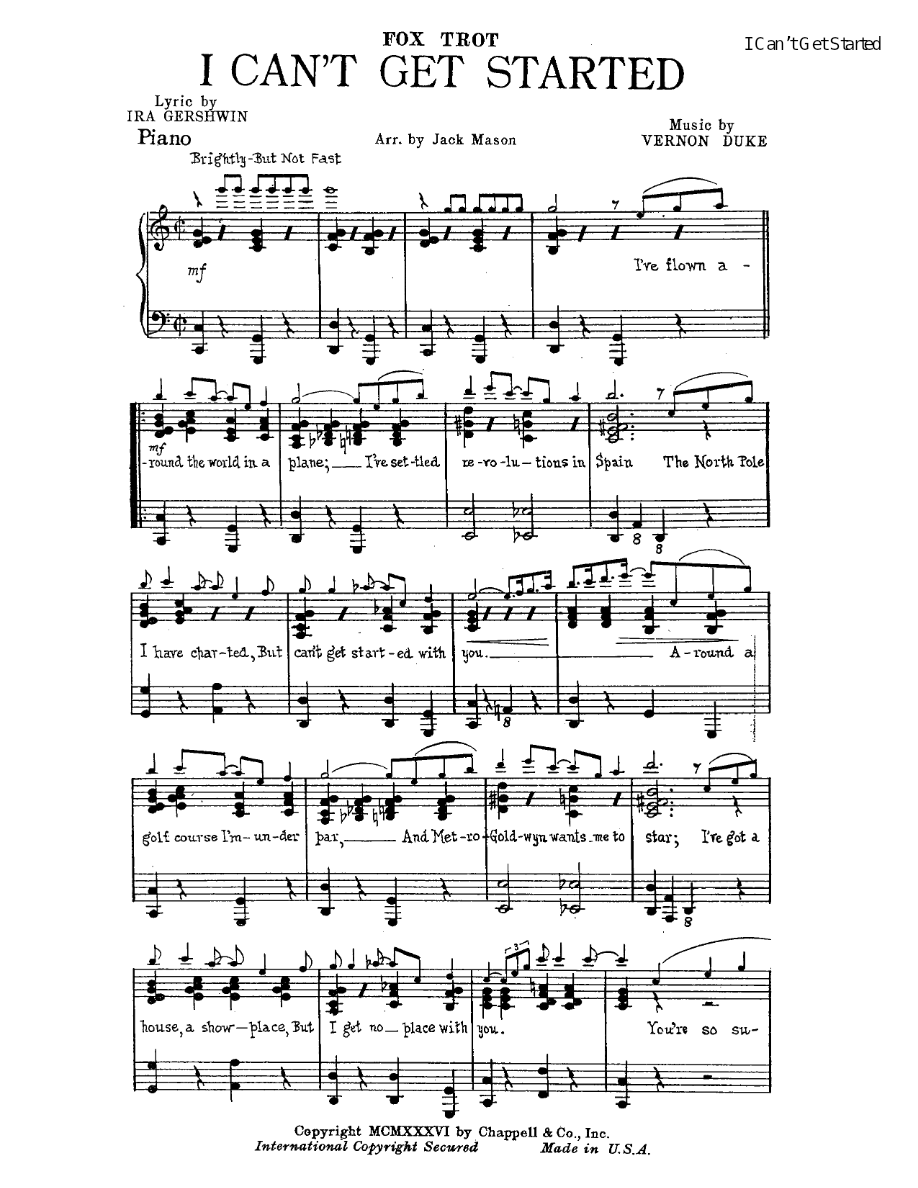
I Can't Get Started (D.Wolpe)
Composed by Ira Gershwin, Vernon Duke
Arranged by Dave Wolpe
- Ensemble: Small Ensemble
- Style: Jazz Standard
- Pages: 27
- Instruments (14): Piano, Drums, Banjo or Guitar, Bass, 1st Trombone, 2nd Trombone, 1st Sax. Eb Alto, 2nd Sax. Bb Tenor, 3rd Sax. Eb Alto, 4th Sax. Eb Bar., 1st Trumpet, 2nd Trumpet in Bb, 3rd Trumpet in Bb, Cello
- Difficulty: easy
- Content: Individual Parts
- Format: PDF Download (Instant)
- Price: $12.99
"I Can't Get Started," a timeless jazz standard, originated as a show tune from the 1936 Broadway musical *Ziegfeld Follies*, composed by Vernon Duke with lyrics by Ira Gershwin. While initially a stage number, it quickly transcended its theatrical roots to become a cornerstone of the jazz repertoire. Its enduring popularity is largely attributed to Bunny Berigan's iconic 1937 recording, which showcased the tune's lyrical beauty and improvisational potential, cementing its status as a vehicle for expressive soloists. The song's sophisticated harmonic progression and poignant melody evoke a sense of unrequited love and longing, making it a favorite for both vocalists and instrumentalists seeking to convey deep emotion. It represents the pinnacle of Tin Pan Alley songwriting, where intricate melodies met clever, heartfelt lyrics, bridging the gap between popular song and the burgeoning jazz idiom of the Swing Era. Dave Wolpe's small ensemble arrangement of "I Can't Get Started" masterfully captures the essence of this classic while infusing it with his signature flair. Wolpe, renowned for his accessible yet musically rich charts, approaches this piece with a medium swing feel, typically around 120-130 BPM, in the key of C Major. The arrangement opens with a beautifully voiced saxophone soli, immediately establishing a warm, inviting mood. Wolpe's voicings are characteristically lush and balanced, providing a full sound even with a smaller instrumentation. The melodic treatment is shared, often featuring the lead alto saxophone or trumpet carrying the primary line, supported by carefully crafted counter-melodies and rhythmic figures in the accompanying horns. The emotional arc is one of gentle introspection, building to moments of understated passion without ever losing its inherent elegance. Performance of this arrangement offers both rewarding challenges and opportunities for expressive playing. The melody is predominantly carried by the lead alto saxophone in the initial statement, with subsequent sections featuring the trumpet and trombone, ensuring all voices have a chance to shine. A significant feature is a well-structured solo section, typically over two choruses, providing ample space for an improvising soloist (often the alto saxophone or trumpet) to explore the tune's rich harmonic landscape. Wolpe’s arrangement includes a dynamic shout chorus that builds intensity through expertly crafted brass figures and saxophone lines, culminating in a satisfying ensemble finish. Technical demands are moderate, focusing more on blend, balance, and rhythmic precision within the swing feel rather than extreme ranges or rapid-fire passages. It’s particularly rewarding for bands that appreciate nuanced phrasing and expressive dynamics. This arrangement is ideally suited for college, community, and advanced high school jazz ensembles. Its small ensemble format makes it perfect for groups with limited instrumentation or those looking to develop tighter, more intimate ensemble playing. The clear articulation and dynamic markings, combined with Wolpe's thoughtful harmonic language, provide an excellent teaching tool for understanding jazz ballad interpretation and ensemble cohesion. Bands will find it appropriate for concert performances, jazz festivals, and educational settings, offering a sophisticated yet approachable rendition of a beloved standard that highlights musicality and ensemble blend. This arrangement of "I Can't Get Started" thrives on a medium swing feel, ideally around 120-130 BPM. Conductors should emphasize a relaxed, yet propulsive, quarter-note pulse, ensuring the eighth notes are swung consistently. The primary technical challenge lies in achieving a seamless blend and balanced voicings, particularly in the saxophone soli sections and the brass figures. Encourage musicians to listen across sections and match articulation and dynamics precisely. Pay close attention to the lyrical phrasing of the melody; avoid overly aggressive attacks, favoring a warm, sustained tone. The solo section provides an excellent opportunity for an improviser to showcase melodic development over the standard changes. Rehearsal tips include isolating the soli passages to perfect intonation and balance, and working on the dynamic swells in the shout chorus to achieve maximum impact without overblowing. No special techniques like plunger mutes or doits are explicitly required, allowing the focus to remain on musicality and ensemble cohesion. Q: What instruments are included in this small ensemble arrangement? A: This arrangement typically includes parts for lead alto saxophone, tenor saxophone, baritone saxophone, 2 trumpets, 1 trombone, piano, bass, and drums, providing a full sound with a compact instrumentation. Q: What is the difficulty level of this arrangement? A: This arrangement is rated as medium difficulty, making it suitable for advanced high school, college, and community jazz ensembles. It requires solid fundamental technique and an understanding of jazz phrasing. Q: What musical style and historical context does this arrangement represent? A: This is a classic jazz standard, originating from the 1936 Broadway musical *Ziegfeld Follies*, arranged in a medium swing style that evokes the sophistication of the Swing Era. Q: What makes Dave Wolpe's arrangement of "I Can't Get Started" unique? A: Wolpe's arrangement is distinguished by its lush, balanced voicings, clear melodic statements shared among sections, and a well-crafted solo section and shout chorus, all presented with his characteristic accessibility and musicality. Q: What is the typical performance duration or tempo for this piece? A: Performed at a medium swing tempo of approximately 120-130 BPM, this arrangement typically has a performance duration of around 3 to 4 minutes, depending on the length of the improvised solo.
Questions and answers
- What is included in the I Can't Get Started (D.Wolpe) PDF?
- The verified current file contains individual parts across 27 pages.
- How many instruments or parts are listed for I Can't Get Started (D.Wolpe)?
- The verified instrumentation list contains 14 entries for this Small Ensemble arrangement.
- Who is credited for I Can't Get Started (D.Wolpe)?
- Composer: Ira Gershwin, Vernon Duke. Arranger: Dave Wolpe.
- What difficulty is listed for I Can't Get Started (D.Wolpe)?
- The verified difficulty level is easy.
- What style is listed for I Can't Get Started (D.Wolpe)?
- The catalog lists the style as Jazz Standard.
- Can I preview I Can't Get Started (D.Wolpe) before buying?
- Yes. The product page provides a preview generated from the current PDF file.
- How is I Can't Get Started (D.Wolpe) delivered?
- After successful payment, the digital PDF is made available for download. The displayed price is $12.99.
Musicians Also Search For
I Can't Get Started Dave Wolpe PDF • I Can't Get Started Dave Wolpe sheet music • I Can't Get Started arranged by Dave Wolpe • Dave Wolpe small ensemble charts • Dave Wolpe jazz arrangements PDF • I Can't Get Started Ira Gershwin, Vernon Duke sheet music • I Can't Get Started Ira Gershwin, Vernon Duke small ensemble arrangements • Ira Gershwin, Vernon Duke small ensemble charts • I Can't Get Started small ensemble arrangements • I Can't Get Started small ensemble PDF download • I Can't Get Started jazz sheet music • small ensemble sheet music download • I Can't Get Started individual parts download • I Can't Get Started sheet music PDF • I Can't Get Started Jazz Standard charts • Jazz Standard small ensemble arrangements • buy I Can't Get Started sheet music • download I Can't Get Started PDF • I Can't Get Started jazz charts • best Dave Wolpe small ensemble arrangements • Ira Gershwin, Vernon Duke arranged by Dave Wolpe • I Can't Get Started printable sheet music • small ensemble repertoire PDF