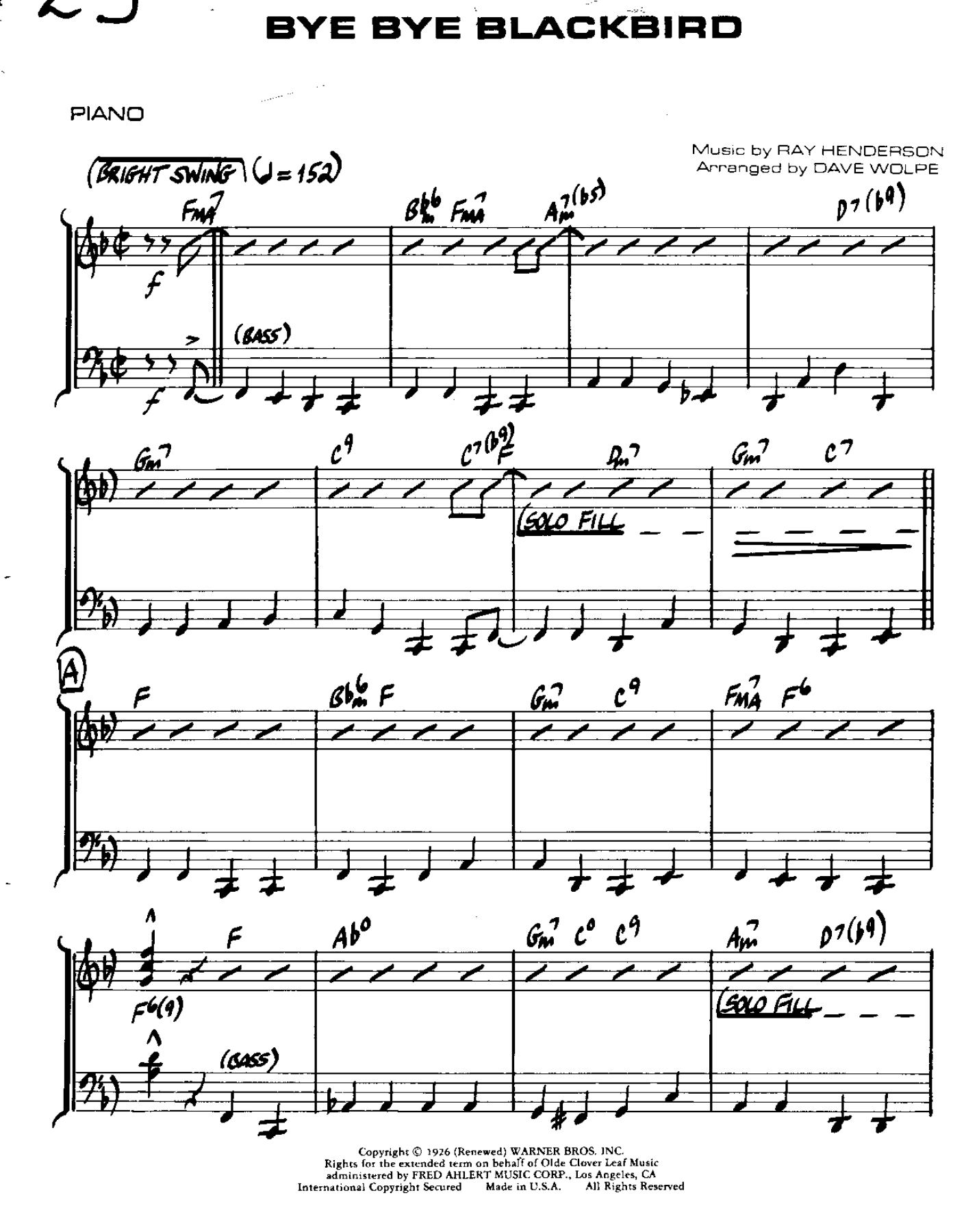
Bye Bye Blackbird-Piano (comp. Ray Henderson)
Composed by Ray Henderson
Arranged by Unknown Arranger
- Ensemble: Small Ensemble
- Style: Jazz Standard
- Pages: 4
- Difficulty: easy
- Content: Sheet Music
- Format: PDF Download (Instant)
- Price: $12.99
First published in 1926 by Ray Henderson, "Bye Bye Blackbird" quickly ascended to prominence as a quintessential American popular song, embodying the effervescent spirit of the Roaring Twenties. Its enduring melodic charm and poignant lyrical narrative—a farewell to a troubled past and a hopeful embrace of the future—cemented its status as a Tin Pan Alley classic. The tune's harmonic simplicity and memorable structure made it an immediate favorite for improvisation, leading to its adoption as a cornerstone jazz standard by the 1930s. Iconic interpretations by artists ranging from Gene Austin and Al Jolson in its early days to later jazz giants like Miles Davis, John Coltrane, and Joe Cocker, showcase its versatility and timeless appeal across diverse musical landscapes. Its consistent presence in the jazz repertoire underscores its fundamental role in the evolution of the genre, offering a familiar yet fertile ground for creative exploration. This particular small ensemble arrangement of "Bye Bye Blackbird" by Unknown Arranger reimagines the standard with a sophisticated, yet accessible, medium swing feel. Rooted firmly in the tradition of classic jazz combos, the arrangement maintains the original's bright, optimistic key of F Major, while subtly introducing extended harmonies that lend a contemporary sheen without sacrificing the tune's historical integrity. The mood is one of buoyant nostalgia, evoking the golden age of jazz clubs with a polished, professional sound. The arrangement's energy is consistently engaging, driven by a solid rhythmic foundation that encourages a relaxed yet propulsive groove. Unknown Arranger's treatment is characterized by elegant voice leading and a clear, articulate presentation of the melody. The opening chorus features a thoughtful piano introduction, setting the stage before the melody is presented in a clear, unadorned fashion, often carried by a lead instrument (e.g., trumpet or saxophone, depending on the ensemble's instrumentation). Subsequent choruses introduce subtle counter-melodies and rhythmic interplay, building dynamic interest. While specific soli sections are not explicitly notated for larger horn sections, the arrangement provides ample space for individual instrumentalists to engage in call-and-response or contribute to the textural fabric. The arrangement notably includes a dedicated solo section over the standard chord changes, offering a fantastic opportunity for improvisation. Technical challenges are primarily centered around maintaining a consistent swing feel, accurate articulation, and navigating the harmonic extensions. The rewarding aspect lies in the ensemble's ability to coalesce around the familiar melody, imbuing it with fresh energy and individual expression. This arrangement is ideally suited for college-level jazz combos, community big band rhythm sections looking for combo material, or professional small ensembles seeking a polished yet flexible chart. Its balanced approach to tradition and subtle modernity makes it an excellent teaching tool for exploring swing phrasing and improvisation, while also providing a satisfying performance piece for experienced musicians. The clear notation and thoughtful structure facilitate quick learning and allow the ensemble to focus on musicality and interaction. Approaching this arrangement of "Bye Bye Blackbird" requires a keen focus on establishing a relaxed, medium swing feel from the outset. The tempo should be comfortably in the range of 120-132 BPM, allowing for clarity in articulation and ample space for rhythmic nuance. The primary technical challenge lies in maintaining a consistent, flowing groove across all rhythm section instruments, particularly the bass and drums, which should provide a solid yet elastic foundation. Pianists should pay close attention to the voicings, ensuring they support the melodic lines without overcrowding the texture. Horn players (if applicable) should strive for a unified sound on the melody, employing a warm, legato articulation that embodies the classic jazz aesthetic. The solo section offers freedom, but soloists should be encouraged to build their improvisations thematically, referencing the original melody or harmonic structure. Rehearsal time should be dedicated to locking in the rhythmic feel and ensuring dynamic contrast, particularly between melody statements and any accompanying figures. No special techniques like plunger mutes or falls are explicitly required, allowing the focus to remain on core jazz performance practices. Q: What instruments/parts are included in this arrangement? A: This arrangement is designed for a small ensemble, typically including parts for Piano, Bass, Drums, and a lead instrument (e.g., C Instrument Lead Sheet, Bb Instrument Lead Sheet, Eb Instrument Lead Sheet) to carry the melody and solos. Q: What is the difficulty level of this arrangement? A: This arrangement is rated as Intermediate. It requires proficiency in reading standard notation, understanding jazz harmony, and a solid grasp of medium swing rhythmic interpretation. Q: What musical style and historical context does this arrangement represent? A: This arrangement is firmly rooted in the Jazz Standard style, specifically a medium swing feel. It pays homage to the classic interpretations of "Bye Bye Blackbird," a popular song from 1926 that became a cornerstone of the jazz repertoire. Q: What makes this arrangement unique compared to other versions of "Bye Bye Blackbird"? A: This Unknown Arranger's treatment is distinguished by its elegant voice leading, subtle harmonic extensions that refresh the standard without altering its core, and a clear focus on providing ample space for both melodic clarity and improvisation within a classic small ensemble setting. Q: What is the typical performance duration or recommended tempo for this piece? A: The typical performance duration for this arrangement is approximately 3-4 minutes, depending on the number and length of improvised solos. The recommended tempo is a medium swing, ideally between 120-132 beats per minute.
Musicians Also Search For
Bye Bye Blackbird-Piano Unknown Arranger PDF • Bye Bye Blackbird-Piano Unknown Arranger sheet music • Bye Bye Blackbird-Piano arranged by Unknown Arranger • Unknown Arranger small ensemble charts • Unknown Arranger jazz arrangements PDF • Bye Bye Blackbird-Piano Ray Henderson sheet music • Bye Bye Blackbird-Piano Ray Henderson small ensemble arrangement • Ray Henderson small ensemble charts • Bye Bye Blackbird-Piano small ensemble arrangement • Bye Bye Blackbird-Piano small ensemble PDF download • Bye Bye Blackbird-Piano jazz ensemble sheet music • small ensemble sheet music instant download • Bye Bye Blackbird-Piano sheet music with parts • Bye Bye Blackbird-Piano Jazz Standard chart • Jazz Standard small ensemble arrangements • buy Bye Bye Blackbird-Piano sheet music online • download Bye Bye Blackbird-Piano PDF • Bye Bye Blackbird-Piano jazz chart • best Unknown Arranger small ensemble arrangements • Ray Henderson songs arranged by Unknown Arranger • Bye Bye Blackbird-Piano printable sheet music • small ensemble repertoire PDF