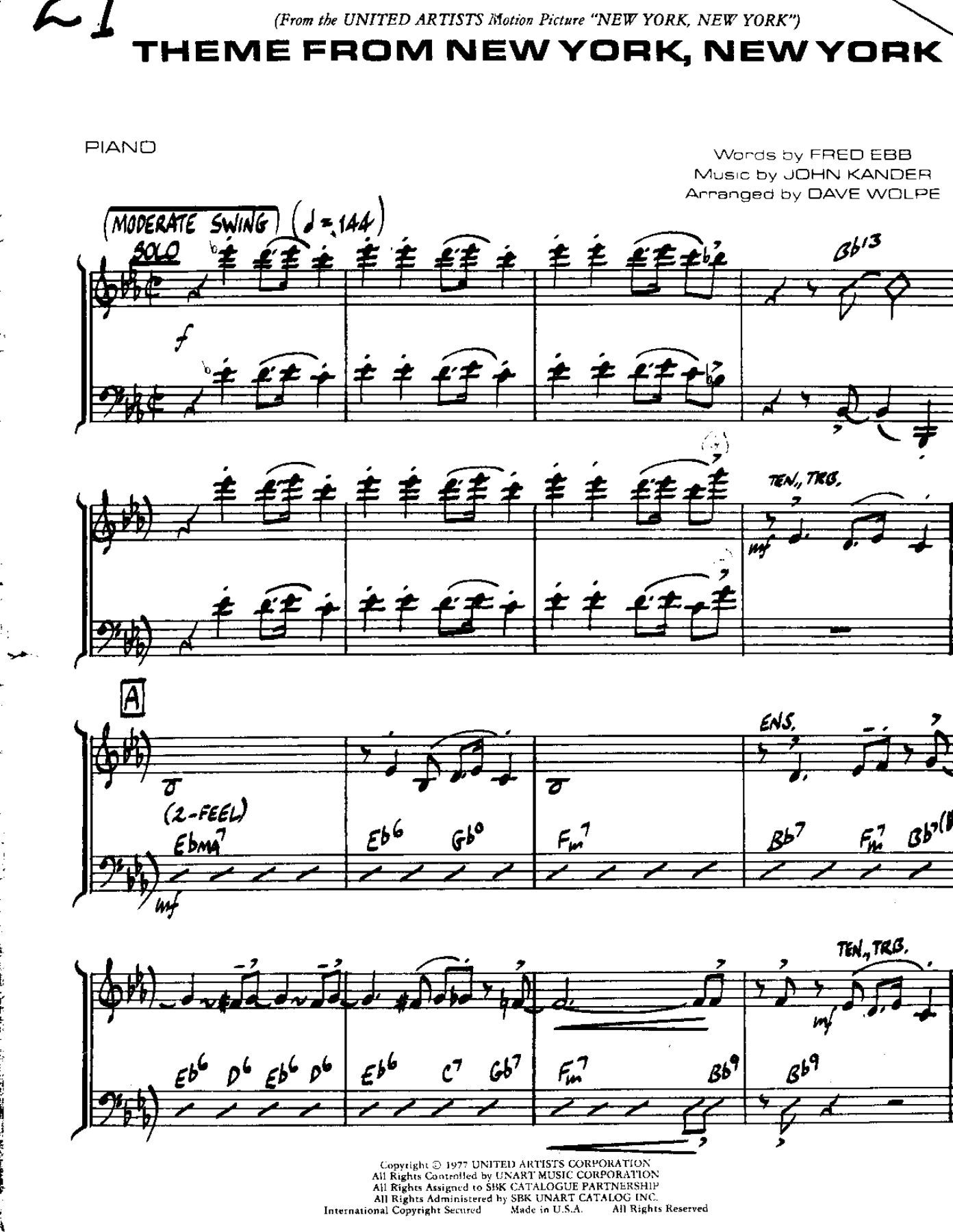
New York-New York (D.Wolpe)
Composed by JOHN KANDER
Arranged by Dave Wolpe
- Ensemble: Small Ensemble
- Style: Jazz Standard
- Pages: 55
- Instruments (21): Alto Sax 1, Alto Sax 2, Tenor Sax 1, Tenor Sax 2, Baryton Sax, Trompette 1, Trompette 2, Trompette 3, Trompette 4, Trombone 1, Trombone 2, Trombone 3, Trombone 4, Violon 1, Violon 2, Violon Alto, Violoncelle, Guitare, Piano, Contrebasse, Drums
- Difficulty: easy
- Content: Individual Parts
- Format: PDF Download (Instant)
- Price: $12.99
The iconic anthem "New York, New York," originally composed by JOHN KANDER for the 1977 film of the same name, soared to global recognition through Frank Sinatra's definitive 1979 recording. This piece embodies the vibrant energy and aspirational spirit of the late 1970s and early 1980s, firmly establishing itself as a quintessential jazz standard and a celebratory ode to the city that never sleeps. Its enduring popularity stems from its memorable melody, powerful lyrics, and its capacity to evoke both the grit and glamour of urban life. The song's structure, typically featuring a verse-chorus form, lends itself well to diverse interpretations, making it a staple in big band and small ensemble repertoires alike. Dave Wolpe's arrangement of "New York-New York" for small ensemble captures the exhilarating essence of the original while infusing it with his signature big band flair, meticulously scaled for a more intimate setting. Wolpe, renowned for his robust and accessible arrangements, typically approaches standards with a keen ear for melodic clarity, rhythmic drive, and rich harmonic textures. This particular chart is set in a vibrant, medium-up swing tempo, maintaining the original's celebratory mood and high energy. The key of F Major provides a bright, open sound, perfectly complementing the song's optimistic character. Wolpe's treatment features sophisticated voicings that create a full, powerful sound despite the smaller instrumentation, often employing tight horn soli sections that mimic the impact of a larger ensemble. The arrangement builds steadily in intensity, culminating in a thrilling shout chorus that is both harmonically inventive and rhythmically compelling, designed to leave a lasting impression. Performance of this arrangement offers numerous rewarding moments. The melody is predominantly carried by the lead trumpet and alto saxophone, often in unison or harmonized lines, ensuring its immediate recognition. While there are no extended open solo sections, Wolpe cleverly integrates short, punchy solo breaks for trumpet and tenor saxophone, providing opportunities for improvisation within the arrangement's framework. These brief features are often set against driving rhythmic figures in the ensemble, maintaining momentum. Technical challenges include precise articulation in the horn lines, particularly during the fast-paced soli sections, and maintaining a consistent, driving swing feel throughout. The brass section will need strong breath support and a bright, focused tone to execute the powerful fanfares and shout chorus effectively. The chart's dynamic contrasts, from crisp ensemble hits to sustained melodic phrases, demand careful attention to detail, making it a rewarding experience for musicians who enjoy a spirited, tight performance. This arrangement is ideally suited for college-level jazz ensembles, advanced community bands, and professional small groups seeking a polished, high-impact rendition of a beloved standard. Its blend of familiar melody with sophisticated arranging techniques provides both challenge and satisfaction, making it a standout addition to any performance repertoire. Conductors should emphasize a consistent, driving medium-up swing feel from the outset, maintaining a strong rhythmic foundation in the bass and drums. The tempo should be energetic but allow for clarity in the horn lines, particularly during the intricate soli passages. Key technical challenges include precise articulation and unified phrasing in the brass and saxophone sections, especially in the syncopated figures of the main theme and the shout chorus. Rehearsal time should be dedicated to balancing the tight voicings, ensuring each voice is heard without overwhelming others. Dynamics are crucial; encourage bold, confident playing in the forte sections and controlled, nuanced delivery in the softer moments. While no special techniques like plunger mutes are explicitly notated, brass players should be prepared for bright, open tones and crisp attacks. Focus on the ensemble's unified attack and release points to achieve a professional, polished sound. Q: What instruments are included in this small ensemble arrangement? A: This arrangement typically includes parts for trumpet, alto saxophone, tenor saxophone, trombone, piano, bass, and drums, providing a full sound for a smaller jazz group. Q: What is the difficulty level of this arrangement? A: This arrangement is considered advanced intermediate to advanced, suitable for college-level jazz ensembles, advanced community bands, and professional small groups due to its demanding horn lines, tight voicings, and need for a strong swing feel. Q: What is the musical style and historical context of "New York-New York (D.Wolpe)"? A: This is a jazz standard arrangement in a medium-up swing style, based on the iconic song composed by JOHN KANDER for the 1977 film "New York, New York," later popularized by Frank Sinatra in 1979. Q: What makes Dave Wolpe's arrangement of "New York-New York" unique? A: Dave Wolpe's arrangement stands out for its ability to create a big band sound with a small ensemble, utilizing sophisticated voicings, tight horn soli sections, and a powerful shout chorus that are characteristic of his accessible yet impactful arranging style. Q: What is the typical performance duration or tempo for this arrangement? A: The arrangement is set at a medium-up swing tempo, and a typical performance duration would be approximately 3 to 4 minutes, depending on the exact tempo chosen and any optional improvisational sections.
Questions and answers
- What is included in the New York-New York (D.Wolpe) PDF?
- The verified current file contains a conductor score and individual parts across 55 pages.
- How many instruments or parts are listed for New York-New York (D.Wolpe)?
- The verified instrumentation list contains 21 entries for this Small Ensemble arrangement.
- Who is credited for New York-New York (D.Wolpe)?
- Composer: JOHN KANDER. Arranger: Dave Wolpe.
- What difficulty is listed for New York-New York (D.Wolpe)?
- The verified difficulty level is easy.
- What style is listed for New York-New York (D.Wolpe)?
- The catalog lists the style as Jazz Standard.
- Can I preview New York-New York (D.Wolpe) before buying?
- Yes. The product page provides a preview generated from the current PDF file.
- How is New York-New York (D.Wolpe) delivered?
- After successful payment, the digital PDF is made available for download. The displayed price is $12.99.
Musicians Also Search For
New York-New York Dave Wolpe PDF • New York-New York Dave Wolpe sheet music • New York-New York arranged by Dave Wolpe • Dave Wolpe small ensemble charts • Dave Wolpe jazz arrangements PDF • New York-New York JOHN KANDER sheet music • New York-New York JOHN KANDER small ensemble arrangements • JOHN KANDER small ensemble charts • New York-New York small ensemble arrangements • New York-New York small ensemble PDF download • New York-New York jazz sheet music • small ensemble sheet music download • New York-New York conductor score PDF • New York-New York individual parts download • New York-New York sheet music PDF • New York-New York Jazz Standard charts • Jazz Standard small ensemble arrangements • buy New York-New York sheet music • download New York-New York PDF • New York-New York jazz charts • best Dave Wolpe small ensemble arrangements • JOHN KANDER arranged by Dave Wolpe • New York-New York printable sheet music • small ensemble repertoire PDF