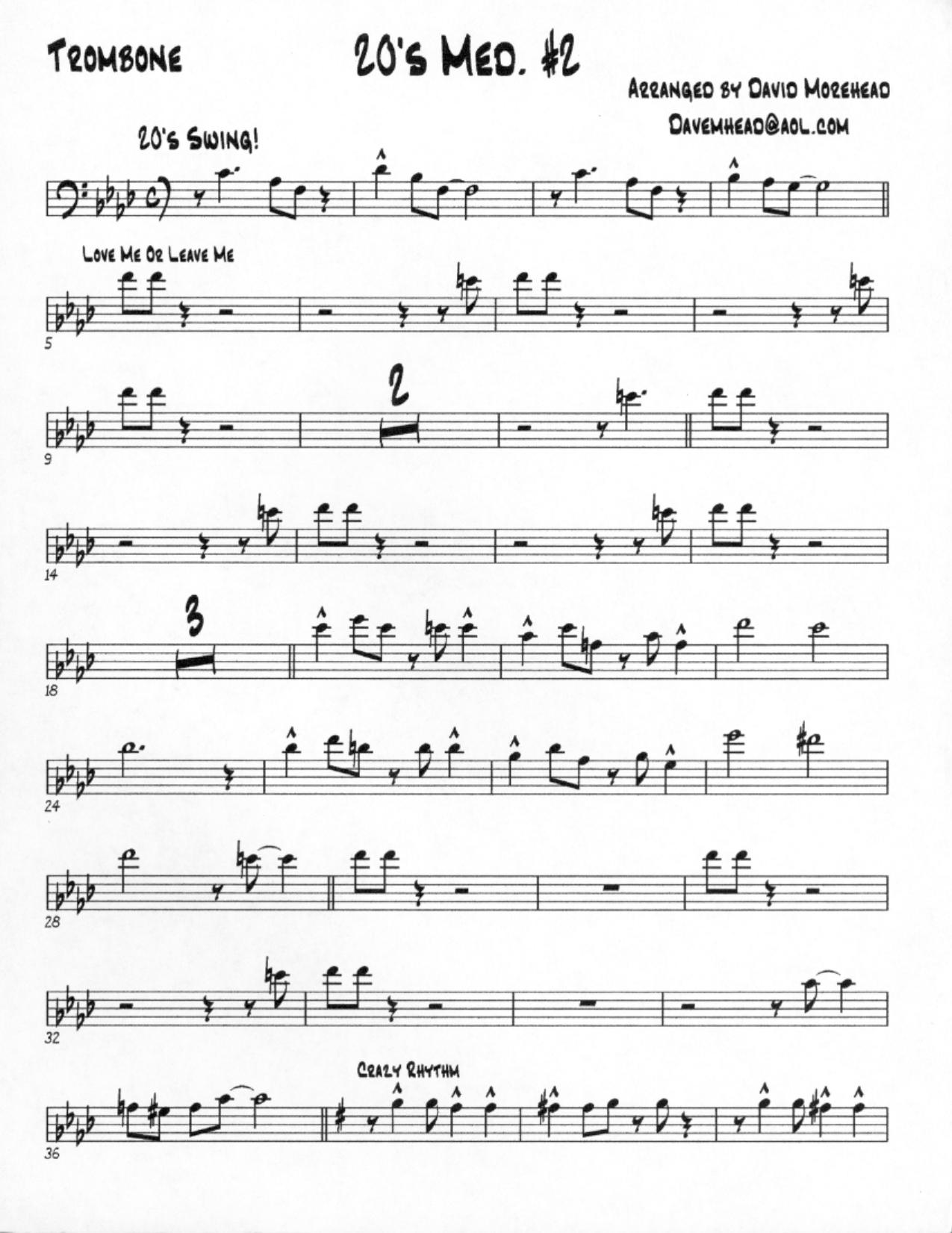
20s2_trombone (D.Morehead)
Composed by David Morehead
Arranged by David Morehead
- Ensemble: Small Ensemble
- Style: Dixieland
- Pages: 3
- Difficulty: easy
- Content: Sheet Music
- Format: PDF Download (Instant)
- Price: $12.99
"20s2_trombone (D.Morehead)" transports listeners directly into the vibrant heart of the Dixieland era, a foundational period in jazz history that emerged from New Orleans in the early 20th century. This arrangement, penned by David Morehead, pays homage to the spirited, improvisational ensemble playing that characterized the 1920s, a decade often referred to as the "Jazz Age." While the original composition is by David Morehead himself, it masterfully captures the essence of early jazz standards made famous by pioneers like Louis Armstrong, Jelly Roll Morton, and King Oliver. The piece embodies the collective improvisation and joyous, often polyphonic, textures that define the Dixieland style, making it a notable example of contemporary writing rooted in historical tradition. It evokes the lively atmosphere of speakeasies and dance halls, celebrating the infectious energy that made jazz a global phenomenon. Musically, "20s2_trombone (D.Morehead)" is a bright, up-tempo Dixieland romp, typically performed with a driving 2-beat feel in 4/4 time, though a subtle swing feel can also be applied for a more modern interpretation. Set in a bright major key, it exudes an undeniably cheerful and celebratory mood. The energy is consistently high, driven by a buoyant rhythmic foundation and intertwining melodic lines. The arrangement immediately establishes its character with a catchy, memorable melody that feels both fresh and authentically vintage. This piece is designed to be an uplifting experience, creating a sense of nostalgic revelry and pure musical enjoyment for both performers and audiences. David Morehead's approach to this small ensemble arrangement is distinctive for its authentic blend of traditional Dixieland elements with accessible, well-crafted voicings. Rather than relying on complex extended harmonies, Morehead focuses on clear, concise melodic statements and counter-melodies that allow each instrument to shine within the collective. The arrangement features the trombone prominently, as suggested by its title, often carrying lead melodic duties or engaging in playful call-and-response with other instruments. Morehead's signature technique here involves crafting intricate yet intuitive interplay, ensuring that the polyphonic texture remains transparent and never becomes muddy. There are moments of tightly woven ensemble sections that mimic the spontaneous feel of early jazz, alongside opportunities for featured soloists to showcase their improvisational prowess over the established harmonic progression. Performance of "20s2_trombone (D.Morehead)" is highly rewarding, offering a chance for musicians to engage with a classic jazz style. The melody is initially presented by the trombone, then often passed to other instruments, encouraging dynamic interplay. There are clearly designated sections for improvised solos, typically over a standard 12-bar blues form or a simple AABA structure, allowing for individual expression. Technical challenges primarily revolve around maintaining the brisk tempo with precision and clarity, especially in the ensemble passages where independent lines must coalesce into a cohesive whole. Articulation must be crisp and light to achieve the authentic Dixieland sound. The piece is suitable for college and community jazz ensembles, as well as professional groups seeking an authentic and engaging Dixieland chart. Its accessible yet authentic nature makes it an excellent choice for developing musicians to learn the nuances of the style, while offering seasoned players a chance to revel in its joyous energy. "20s2_trombone (D.Morehead)" is best performed with a bright, driving tempo around quarter note = 180-200 BPM, maintaining a crisp, energetic 2-beat feel. Emphasize light, detached articulation, especially in the brass, to achieve the characteristic Dixieland bounce. The primary technical challenge lies in maintaining clarity within the polyphonic ensemble sections; encourage musicians to listen across the ensemble to ensure their individual lines interlock rather than clash. Balance is crucial: the lead melody should always be prominent, but the counter-melodies and rhythmic accompaniment must provide a strong, supportive foundation. No special techniques like plunger mutes or doits are explicitly required, though tasteful use of falls and scoops can enhance the authentic feel. During rehearsals, focus on rhythmic precision in the ensemble passages and encourage soloists to embrace the melodic and harmonic language of traditional Dixieland. Q: What instruments and parts are included in this arrangement? A: This small ensemble arrangement typically includes parts for Trumpet, Clarinet, Trombone, Piano, Bass, and Drums, allowing for the classic Dixieland instrumentation. Q: What is the difficulty level of "20s2_trombone (D.Morehead)"? A: This arrangement is rated as medium difficulty, suitable for intermediate to advanced high school, college, and community jazz ensembles. It requires good rhythmic precision and an understanding of Dixieland style. Q: What musical style and historical context does this arrangement represent? A: "20s2_trombone (D.Morehead)" is a contemporary original composition written in the Dixieland style, evoking the vibrant jazz of the 1920s with its collective improvisation and joyful, up-tempo feel. Q: What makes David Morehead's arrangement of this piece unique? A: David Morehead's treatment is distinctive for its authentic capture of the Dixieland spirit through well-crafted, transparent voicings and clear melodic lines, making the polyphonic texture accessible and engaging while prominently featuring the trombone. Q: What is the approximate performance duration and recommended tempo for this piece? A: The performance duration typically ranges from 3 to 4 minutes, depending on the number and length of improvised solos. The recommended tempo is a bright, driving quarter note = 180-200 BPM.
Musicians Also Search For
20s2_trombone David Morehead PDF • 20s2_trombone David Morehead sheet music • 20s2_trombone arranged by David Morehead • David Morehead small ensemble charts • David Morehead jazz arrangements PDF • 20s2_trombone David Morehead small ensemble arrangement • 20s2_trombone small ensemble arrangement • 20s2_trombone small ensemble PDF download • 20s2_trombone jazz ensemble sheet music • small ensemble sheet music instant download • 20s2_trombone sheet music with parts • 20s2_trombone Dixieland chart • Dixieland small ensemble arrangements • buy 20s2_trombone sheet music online • download 20s2_trombone PDF • 20s2_trombone jazz chart • best David Morehead small ensemble arrangements • 20s2_trombone printable sheet music • small ensemble repertoire PDF