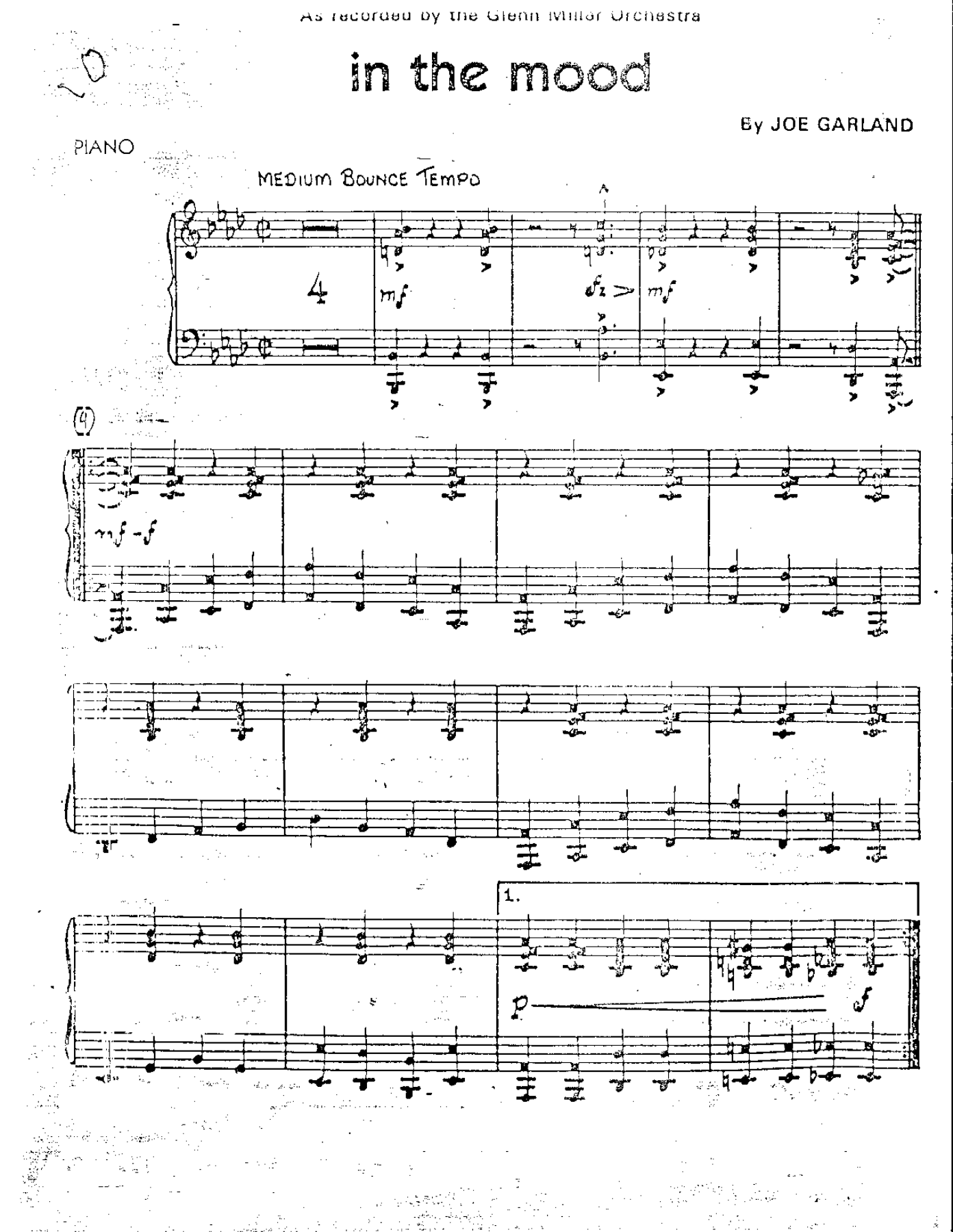
In the Mood-Piano (comp. Joe Garland)
Composed by Joe Garland
Arranged by Glenn Miller
- Ensemble: Small Ensemble
- Style: Swing
- Pages: 5
- Instruments (1): piano
- Difficulty: easy
- Content: Individual Parts
- Format: PDF Download (Instant)
- Price: $12.99
Joe Garland's iconic "In the Mood" stands as a quintessential anthem of the Swing Era, forever etched into the annals of American music history. Composed in 1939, it quickly became synonymous with the big band sound, most famously popularized by Glenn Miller and His Orchestra. Its infectious, driving rhythm and memorable melodic hooks captured the exuberant spirit of pre-war America, becoming a global sensation and a foundational piece in the jazz standard repertoire. The piece's enduring appeal lies in its simple yet incredibly effective 12-bar blues structure, combined with a call-and-response motif that invites immediate engagement from listeners and performers alike. Its original recording's distinctive saxophone soli and brass interjections defined a genre, making it a benchmark for swing arrangements. This particular arrangement, titled "In the Mood-Piano (comp. Joe Garland)," offers a fresh, intimate perspective on the classic. While the original is known for its large ensemble power, this treatment for a small ensemble, specifically featuring the piano, reimagines the piece with a focus on clarity and nuanced interplay. The arranger, though unknown, demonstrates a keen understanding of the original's essence, translating its robust energy into a more agile and transparent setting. Expect a medium-up swing tempo, maintaining the original's buoyant 4/4 feel in the key of A-flat major, which provides a rich, warm tonal palette. The mood is undeniably upbeat and celebratory, evoking the joyous dance halls of the swing era but with a refined chamber jazz sensibility. The arranger's approach is characterized by intelligent voicings that allow each instrument to contribute significantly without overwhelming the texture. The piano takes a prominent role, often presenting the primary melodic statements, but also engaging in intricate counterpoint and rhythmic accompaniment. Soli sections are crafted to highlight the individual voices within the small ensemble, creating a dynamic dialogue. While there may not be a traditional "shout chorus" in the big band sense, the arrangement builds intensity through rhythmic layering and harmonic development, culminating in a satisfying climax. Featured solos are integral, providing opportunities for improvisation over the familiar blues changes, which are clearly outlined. Technically, the arrangement is accessible yet engaging, requiring solid rhythmic precision and a good understanding of swing articulation from all players. The rewarding aspect lies in the ensemble's ability to capture the original's spirit through a more delicate, interactive lens, allowing for greater individual expression. This arrangement is ideally suited for college-level jazz ensembles, community bands with proficient musicians, or even professional small groups seeking a classic piece with a fresh, playable chart. Its five-page length suggests a concise yet comprehensive treatment, perfect for concert programs or casual performances where a tight, well-executed swing number is desired. It allows for exploration of swing dynamics and articulation in a setting that encourages listening and interaction among a smaller group of musicians, making it an excellent educational tool as well as a performance-ready piece. To capture the authentic feel of "In the Mood," maintain a consistent medium-up swing tempo (around 160-180 bpm) with a strong emphasis on the quarter-note pulse. The rhythmic precision in the ensemble hits and the characteristic "stop-time" sections are paramount; ensure these are locked in tightly. Articulation is key: brass should have crisp, short notes on figures like the iconic "da-da-da-DUM" motif, while saxophones should employ a smooth, connected swing legato where appropriate. The piano, often carrying the melody or prominent counter-melodies, needs a clear, articulate touch, especially in the upper register. Encourage soloists to embrace the bluesy nature of the changes, utilizing classic swing vocabulary. Rehearsal time should focus on dynamic contrasts, ensuring the arrangement breathes and builds naturally, avoiding a flat, uninspired delivery. Pay close attention to the subtle harmonic shifts and inner voice movement, which add depth to this small ensemble rendition. Q: What instruments or parts are included in this arrangement? A: This arrangement is for a small ensemble, specifically titled "In the Mood-Piano," suggesting a prominent role for the piano. While the exact instrumentation beyond piano isn't listed, small ensemble arrangements typically include bass, drums, and potentially one or two melodic instruments (e.g., saxophone, trumpet). Q: What is the difficulty level of this arrangement? A: This arrangement is suitable for college-level jazz ensembles, community bands with proficient musicians, or professional small groups. It requires solid rhythmic precision, good articulation, and an understanding of swing feel, making it an intermediate to advanced level piece. Q: What musical style and historical context does "In the Mood" represent? A: "In the Mood" is a quintessential Swing Era piece, composed by Joe Garland in 1939. It embodies the energetic, danceable big band sound popularized by Glenn Miller, characterized by its driving medium-up swing tempo and memorable blues-based melodies. Q: What makes this specific arrangement unique compared to other versions of "In the Mood"? A: This arrangement distinguishes itself by reimagining the classic big band tune for a small ensemble with a prominent piano feature. It focuses on clarity, nuanced interplay, and intelligent voicings, offering a more intimate yet equally energetic interpretation of the original. Q: What is the typical performance duration or tempo for this piece? A: Given its medium-up swing tempo (around 160-180 bpm) and five-page length, a typical performance duration for this arrangement would likely be in the range of 3-5 minutes, depending on the number and length of improvised solos.
Questions and answers
- What is included in the In the Mood-Piano (comp. Joe Garland) PDF?
- The verified current file contains individual parts across 5 pages.
- How many instruments or parts are listed for In the Mood-Piano (comp. Joe Garland)?
- The verified instrumentation list contains 1 entries for this Small Ensemble arrangement.
- Who is credited for In the Mood-Piano (comp. Joe Garland)?
- Composer: Joe Garland. Arranger: Glenn Miller.
- What difficulty is listed for In the Mood-Piano (comp. Joe Garland)?
- The verified difficulty level is easy.
- What style is listed for In the Mood-Piano (comp. Joe Garland)?
- The catalog lists the style as Swing.
- Can I preview In the Mood-Piano (comp. Joe Garland) before buying?
- Yes. The product page provides a preview generated from the current PDF file.
- How is In the Mood-Piano (comp. Joe Garland) delivered?
- After successful payment, the digital PDF is made available for download. The displayed price is $12.99.
Musicians Also Search For
In the Mood-Piano Glenn Miller PDF • In the Mood-Piano Glenn Miller sheet music • In the Mood-Piano arranged by Glenn Miller • Glenn Miller small ensemble charts • Glenn Miller jazz arrangements PDF • In the Mood-Piano Joe Garland sheet music • In the Mood-Piano Joe Garland small ensemble arrangements • Joe Garland small ensemble charts • In the Mood-Piano small ensemble arrangements • In the Mood-Piano small ensemble PDF download • In the Mood-Piano jazz sheet music • small ensemble sheet music download • In the Mood-Piano individual parts download • In the Mood-Piano sheet music PDF • In the Mood-Piano Swing charts • Swing small ensemble arrangements • buy In the Mood-Piano sheet music • download In the Mood-Piano PDF • In the Mood-Piano jazz charts • best Glenn Miller small ensemble arrangements • Joe Garland arranged by Glenn Miller • In the Mood-Piano printable sheet music • small ensemble repertoire PDF