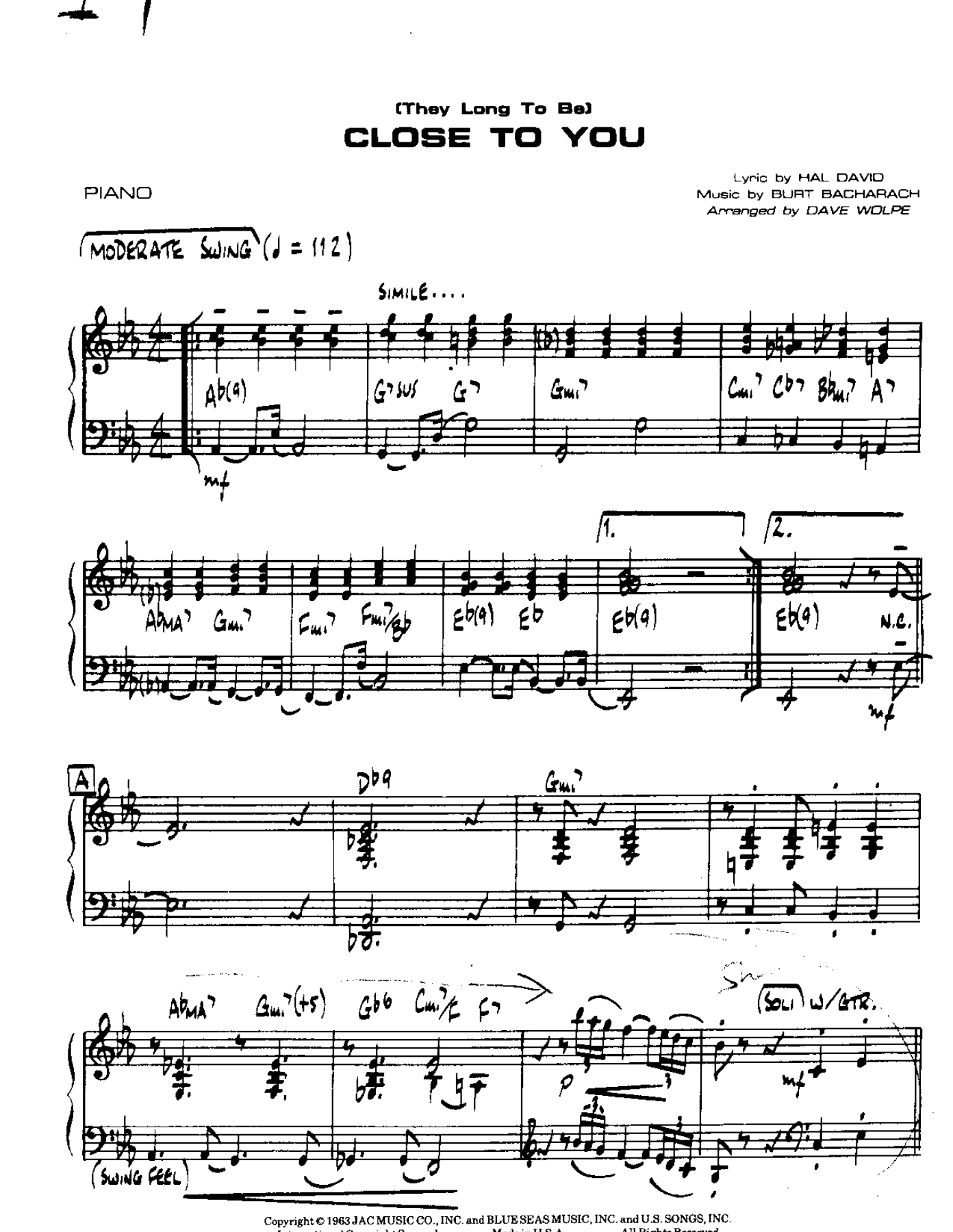
Close To You (D.Wolpe) sheet music preview

Close To You (D.Wolpe)

Composed by Burt Bacharach

Arranged by Dave Wolpe

  • Ensemble: Small Ensemble
  • Style: Jazz Standard
  • Pages: 21
  • Instruments (19): Conductor, Vocal, Piano, Basses, Guitar, Drums, 1st Eb Alto Saxophone, 3rd Eb Alto Saxophone, 2nd Bb Tenor Saxophone, 4th Bb Tenor Saxophone, 5th Eb Baritone Saxophone, 1st Trombone, 2nd Trombone, 3rd Trombone, 4th Trombone, 1st Bb Trumpet, 2nd Bb Trumpet, 3rd Bb Trumpet, 4th Bb Trumpet
  • Difficulty: easy
  • Content: Individual Parts
  • Format: PDF Download (Instant)
  • Price: $12.99

Burt Bacharach's timeless ballad, "Close To You," originally titled "(They Long to Be) Close to You," first gained widespread recognition with Richard Chamberlain's 1963 recording, but it was The Carpenters' iconic 1970 rendition that cemented its status as a global phenomenon and an enduring pop standard. This song, a quintessential example of the sophisticated pop and easy listening sound of the late 1960s and early 1970s, features Bacharach's signature blend of intricate melodies, unconventional time signatures, and lush orchestrations. Its lyrical theme of yearning and idealized love, combined with its memorable melodic contours, has made it a favorite across genres, leading to its adoption into the jazz repertoire. The piece evokes a sense of gentle romance and wistful affection, characterized by its smooth, flowing lines and harmonic richness. Dave Wolpe's arrangement of "Close To You" transforms this beloved pop classic into a beautifully crafted small ensemble jazz ballad. Wolpe, renowned for his ability to imbue familiar tunes with fresh jazz sensibilities while respecting their original character, approaches this piece with a medium-slow ballad tempo, typically around 60-70 beats per minute, maintaining the original key of D-flat major. His signature style often incorporates rich, warm voicings and a focus on lyrical phrasing, which is evident throughout this arrangement. The musical character is one of understated elegance and emotional depth, designed to evoke a tender, reflective mood rather than a boisterous one. It sounds sophisticated and smooth, allowing the inherent beauty of Bacharach's melody to shine through its jazz harmonization. The arrangement features the melody primarily carried by the lead alto saxophone, which often doubles with the lead trumpet for added warmth and blend, creating a cohesive and expressive front-line sound. There are no extended improvised solo sections, allowing the ensemble to focus on collective interpretation and blend. However, there are opportunities for sensitive melodic embellishment within the written parts, particularly in the lead voices. Wolpe masterfully employs extended harmonies and subtle counter-melodies, enriching the original structure without overwhelming it. The technical challenges lie more in achieving a unified, expressive sound, maintaining impeccable intonation, and delivering the nuanced dynamics required for a convincing ballad performance. The rewarding aspect of performing this piece comes from its ability to connect emotionally with an audience through its beautiful melody and sophisticated harmonic treatment. This arrangement is ideally suited for advanced high school, college, community, and professional small jazz ensembles. Its demands on blend, intonation, and sensitive phrasing make it an excellent vehicle for developing musical maturity and ensemble cohesion. The 16 pages of score and parts provide a concise yet complete musical statement. While technically accessible to many, its true depth is unlocked by musicians who can bring a refined sense of musicality and emotional understanding to their performance, making it a valuable addition to any ensemble's repertoire. Conductors should emphasize a unified, legato approach throughout the ensemble to achieve the desired smooth ballad feel. The primary technical challenge lies in maintaining precise intonation, especially within the close voicings and sustained chords. Encourage musicians to listen across sections and blend seamlessly. The tempo marking should be observed as a medium-slow ballad, approximately quarter note = 60-70, allowing ample space for melodic expression and harmonic resonance. Dynamics are crucial; subtle crescendos and decrescendos should be carefully shaped to enhance the emotional arc of the piece. There are no special techniques like plunger mutes or falls required, focusing instead on pure tone and lyrical phrasing. Rehearsal time should be dedicated to balancing the lead voices, ensuring the melody is always prominent but never harsh, and refining the ensemble's collective interpretation of the piece's tender mood. Q: What instruments/parts are included in the "Close To You (D.Wolpe)" arrangement? A: This small ensemble arrangement typically includes parts for lead alto saxophone, lead trumpet, piano, bass, and drums, providing a complete and balanced jazz combo sound. Q: What is the difficulty level of this arrangement? A: This arrangement is considered advanced high school, college, or community level. While not overtly technically challenging in terms of speed, it demands a high level of musicality, blend, intonation, and sensitive phrasing. Q: What is the musical style and historical context of this arrangement? A: This is a jazz standard arrangement of Burt Bacharach's classic "Close To You," originally popularized by The Carpenters in 1970. It embodies a sophisticated, medium-slow jazz ballad style, reflecting the lush harmonic and melodic characteristics of the original while reharmonized for a jazz ensemble. Q: What makes Dave Wolpe's arrangement of "Close To You" unique? A: Dave Wolpe's signature approach brings rich, warm voicings and a focus on lyrical phrasing to this classic. He maintains the original key of D-flat major and transforms the pop standard into an elegant jazz ballad, emphasizing ensemble blend and emotional depth over extended solos. Q: What is the typical performance duration or tempo for this piece? A: The arrangement is intended as a medium-slow ballad, with a tempo typically around 60-70 beats per minute. The total performance duration will vary slightly based on interpretation but generally falls within the 3 to 4-minute range.

Questions and answers

What is included in the Close To You (D.Wolpe) PDF?
The verified current file contains a conductor score and individual parts across 21 pages.
How many instruments or parts are listed for Close To You (D.Wolpe)?
The verified instrumentation list contains 19 entries for this Small Ensemble arrangement.
Who is credited for Close To You (D.Wolpe)?
Composer: Burt Bacharach. Arranger: Dave Wolpe.
What difficulty is listed for Close To You (D.Wolpe)?
The verified difficulty level is easy.
What style is listed for Close To You (D.Wolpe)?
The catalog lists the style as Jazz Standard.
Can I preview Close To You (D.Wolpe) before buying?
Yes. The product page provides a preview generated from the current PDF file.
How is Close To You (D.Wolpe) delivered?
After successful payment, the digital PDF is made available for download. The displayed price is $12.99.

Musicians Also Search For

Close To You Dave Wolpe PDFClose To You Dave Wolpe sheet musicClose To You arranged by Dave WolpeDave Wolpe small ensemble chartsDave Wolpe jazz arrangements PDFClose To You Burt Bacharach sheet musicClose To You Burt Bacharach small ensemble arrangementsBurt Bacharach small ensemble chartsClose To You small ensemble arrangementsClose To You small ensemble PDF downloadClose To You jazz sheet musicsmall ensemble sheet music downloadClose To You conductor score PDFClose To You individual parts downloadClose To You sheet music PDFClose To You Jazz Standard chartsJazz Standard small ensemble arrangementsbuy Close To You sheet musicdownload Close To You PDFClose To You jazz chartsbest Dave Wolpe small ensemble arrangementsBurt Bacharach arranged by Dave WolpeClose To You printable sheet musicsmall ensemble repertoire PDF

All arrangements by Dave Wolpe All Burt Bacharach sheet music