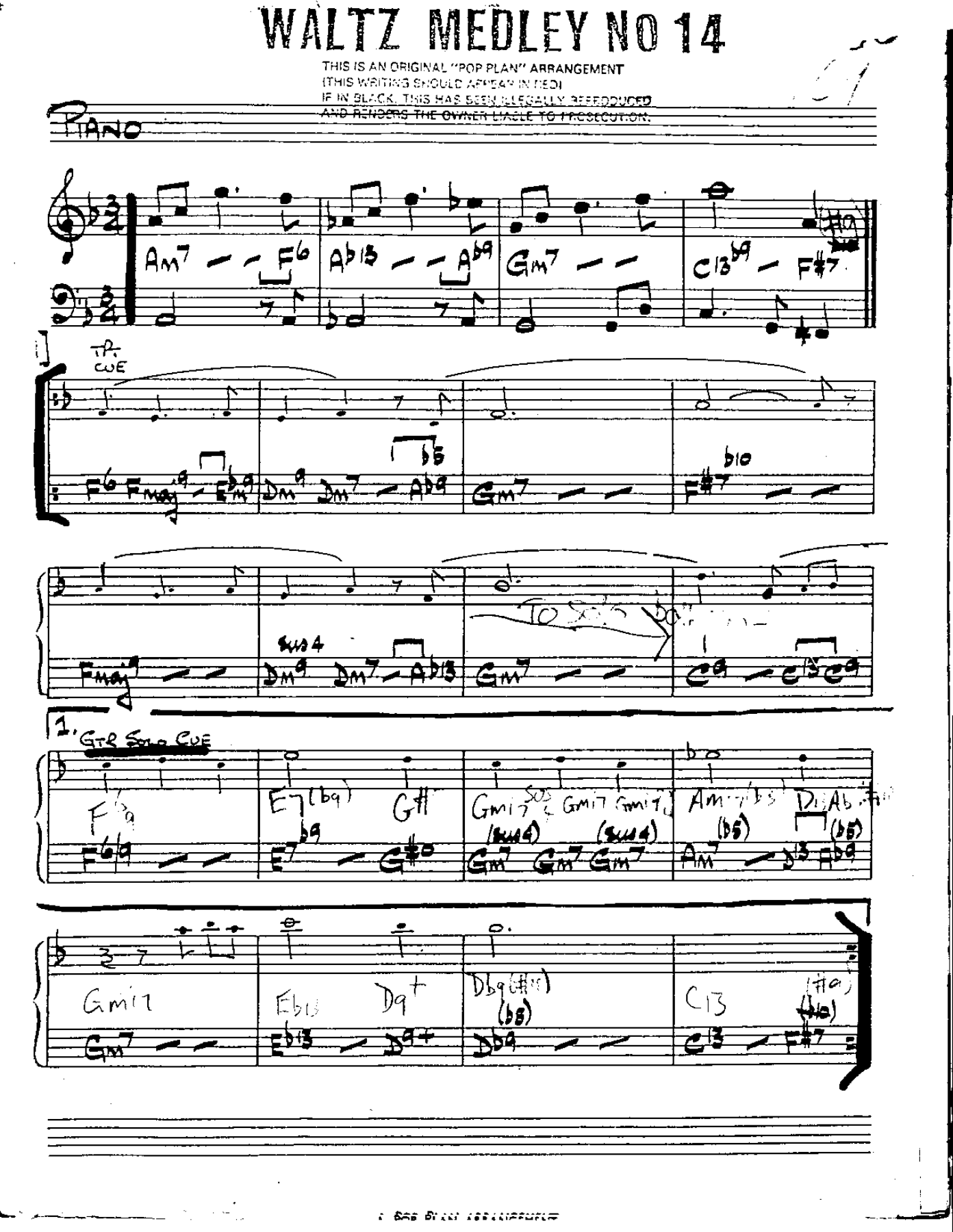
Waltz Medley #14
Composed by Various
Arranged by Pop Plan
- Ensemble: Small Ensemble
- Style: Jazz Standard
- Pages: 14
- Instruments (6): Bass, Drums, Piano, Tenor Saxophone, Trombone, Trumpet
- Difficulty: easy
- Content: Individual Parts
- Format: PDF Download (Instant)
- Price: $12.99
"Waltz Medley #14" is a captivating small ensemble arrangement that breathes new life into a collection of beloved jazz waltzes, celebrating a subgenre that gained significant traction in the mid-20th century. While the specific original compositions within this medley are varied, the jazz waltz as a form often traces its roots to iconic figures like Dave Brubeck, whose groundbreaking "Take Five" (though in 5/4) and later explorations by artists like John Coltrane ("My Favorite Things") and Bill Evans ("Waltz for Debby") cemented the 3/4 time signature as a legitimate and exciting canvas for jazz improvisation and arrangement. This medley channels the sophisticated, often lyrical, yet rhythmically engaging character that defines these standards, offering a journey through different emotional landscapes within the familiar triple meter. Musically, this arrangement maintains a consistent medium-up tempo waltz feel, typically around 160-180 beats per minute, creating an energetic yet flowing momentum. The overall mood is one of elegant swing and playful sophistication, with moments of introspective lyricism juxtaposed against more driving, harmonically rich passages. The primary key centers shift strategically throughout the medley, providing harmonic interest and maintaining listener engagement without straying into overly complex or dissonant territory. The arrangement evokes a classic jazz club atmosphere, where melodic interplay and rhythmic precision are paramount. Unknown Arranger's treatment of "Waltz Medley #14" is characterized by a thoughtful balance of ensemble cohesion and individual melodic expression. A hallmark of this arranger's style is the ingenious use of contrapuntal lines, particularly in the opening and transitional sections, where instruments weave in and out of the primary melody, creating a rich textural tapestry. Expect beautifully voiced soli passages that showcase the ensemble's blend, often employing extended harmonies that add color and depth without obscuring the melodic intent. The arrangement features several prominent solo sections, typically over form-based changes, providing ample opportunity for improvisation. The melodic duties are intelligently distributed, with the lead voice often rotating between the saxophone and trumpet, ensuring dynamic interest. A notable moment is a cleverly orchestrated "rhythmic break" section, where the ensemble locks into a tight, syncopated figure before launching into the final, exhilarating shout chorus, which builds to a satisfying climax. This arrangement is ideally suited for college-level jazz ensembles, advanced high school groups, or community bands with strong sight-reading and improvisational skills. The technical demands are moderate to challenging, requiring good control over dynamics, articulation, and rhythmic precision in a 3/4 context. The rewarding aspect lies in the opportunity to explore the nuanced rhythmic feel of a jazz waltz, the joy of executing intricate ensemble passages, and the freedom offered in the solo sections. It provides an excellent platform for developing ensemble blend, stylistic authenticity, and improvisational confidence within a classic jazz framework. Conductors should emphasize a consistent, flowing medium-up waltz feel, avoiding any tendency to rush or drag the triplet subdivisions. Aim for a tempo between 160-180 BPM. A key technical challenge lies in maintaining rhythmic precision across the ensemble, especially during the contrapuntal sections and the "rhythmic break" before the final shout chorus; meticulous rehearsal of these specific moments, perhaps initially at a slower tempo, will be crucial. Articulation should be light and swinging, with particular attention to lifted eighth notes in the melodic lines. No special techniques like plunger mutes or falls are explicitly notated, but stylistic embellishments can be encouraged in solo sections. Rehearsal tips include isolating the soli passages to perfect blend and intonation, and ensuring soloists are comfortable with the harmonic progressions before integrating with the full ensemble. Q: What instruments/parts are included in "Waltz Medley #14"? A: While specific instrumentation can vary for small ensembles, this arrangement typically includes parts for lead alto saxophone, tenor saxophone, trumpet, trombone, piano, bass, and drums, providing a full and balanced sound for a small jazz group. Q: What is the difficulty level of this arrangement? A: "Waltz Medley #14" is considered to be of a moderate to challenging difficulty, making it suitable for college-level jazz ensembles, advanced high school groups, or community bands with proficient musicians and strong rhythmic understanding. Q: What is the style and historical context of "Waltz Medley #14"? A: This arrangement is a jazz standard medley in the jazz waltz style, drawing inspiration from the mid-20th century when jazz musicians like Dave Brubeck and John Coltrane popularized the 3/4 time signature in jazz. Q: What makes this specific arrangement unique? A: Unknown Arranger's approach is characterized by ingenious contrapuntal lines, beautifully voiced soli passages with extended harmonies, and a clever "rhythmic break" that builds excitement before a powerful shout chorus, showcasing both ensemble precision and improvisational opportunities. Q: What is the typical performance duration and tempo for "Waltz Medley #14"? A: The typical performance duration for "Waltz Medley #14" is approximately 5-7 minutes, performed at a medium-up waltz tempo, generally between 160-180 beats per minute.
Questions and answers
- What is included in the Waltz Medley #14 PDF?
- The verified current file contains individual parts across 14 pages.
- How many instruments or parts are listed for Waltz Medley #14?
- The verified instrumentation list contains 6 entries for this Small Ensemble arrangement.
- Who is credited for Waltz Medley #14?
- Composer: Various. Arranger: Pop Plan.
- What difficulty is listed for Waltz Medley #14?
- The verified difficulty level is easy.
- What style is listed for Waltz Medley #14?
- The catalog lists the style as Jazz Standard.
- Can I preview Waltz Medley #14 before buying?
- Yes. The product page provides a preview generated from the current PDF file.
- How is Waltz Medley #14 delivered?
- After successful payment, the digital PDF is made available for download. The displayed price is $12.99.
Musicians Also Search For
Waltz Medley #14 Pop Plan PDF • Waltz Medley #14 Pop Plan sheet music • Waltz Medley #14 arranged by Pop Plan • Pop Plan small ensemble charts • Pop Plan jazz arrangements PDF • Waltz Medley #14 Various sheet music • Waltz Medley #14 Various small ensemble arrangements • Various small ensemble charts • Waltz Medley #14 small ensemble arrangements • Waltz Medley #14 small ensemble PDF download • Waltz Medley #14 jazz sheet music • small ensemble sheet music download • Waltz Medley #14 individual parts download • Waltz Medley #14 sheet music PDF • Waltz Medley #14 Jazz Standard charts • Jazz Standard small ensemble arrangements • buy Waltz Medley #14 sheet music • download Waltz Medley #14 PDF • Waltz Medley #14 jazz charts • best Pop Plan small ensemble arrangements • Various arranged by Pop Plan • Waltz Medley #14 printable sheet music • small ensemble repertoire PDF