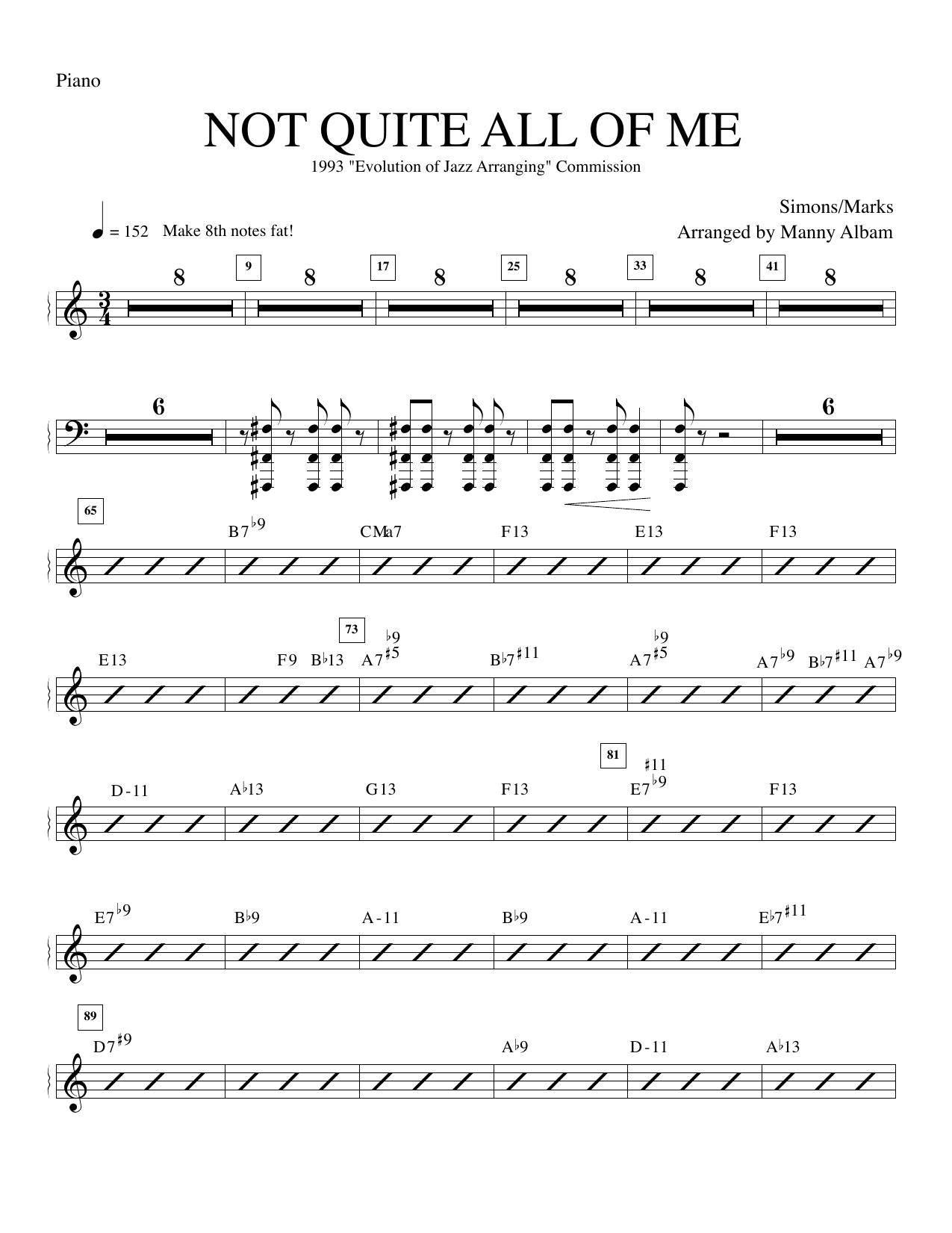
13. Piano (M.Albam) sheet music preview

13. Piano (M.Albam)

Composed by Simons/Marks

Arranged by Manny Albam

  • Ensemble: Small Ensemble
  • Style: Jazz Standard
  • Pages: 4
  • Instruments (1): Piano
  • Difficulty: easy
  • Content: Individual Parts
  • Format: PDF Download (Instant)
  • Price: $12.99

The jazz standard "13. Piano," originally composed by Simons and Marks, emerges from the rich tapestry of the American Songbook, a collection of popular songs from the early to mid-20th century that have become foundational to jazz repertoire. While the specific title "13. Piano" might suggest a particular instrumental focus or a track number from a larger work, the underlying composition likely hails from an era when Tin Pan Alley melodies and Broadway tunes provided fertile ground for improvisation and reinterpretation. These compositions, often characterized by their memorable melodies, sophisticated harmonic progressions, and lyrical depth, became the vehicles for countless jazz artists, cementing their status as enduring standards. The original works were often popularized by vocalists and big bands of the swing era, embodying the sophisticated yet accessible sound that defined American popular music for decades. Manny Albam's arrangement of "13. Piano" for small ensemble masterfully recontextualizes this classic, infusing it with his characteristic blend of harmonic sophistication and rhythmic vitality. Albam, known for his innovative writing for both big bands and smaller groups, approaches this piece with a medium swing feel, maintaining the inherent groove of the standard while adding layers of modern jazz sensibility. The arrangement is likely set in a comfortable, accessible key, allowing for expressive melodic lines and fluid harmonic movement. Listeners can expect a mood that is at once nostalgic and fresh, evoking the timeless elegance of the jazz tradition while presenting it through Albam's distinctive lens. His arrangements often feature intricate counterpoint, rich voicings that extend beyond simple block chords, and a keen sense of dynamic shaping that builds and releases tension effectively. Albam's distinctive approach often involves clever reharmonizations and a focus on ensemble interplay, even within a small group setting. In "13. Piano," the melody is likely presented initially by one or more horns, perhaps with a beautifully voiced piano accompaniment, before transitioning into a more developed soli section where the ensemble plays a harmonized melodic line. Expect carefully crafted shout choruses that build excitement, showcasing Albam's mastery of ensemble writing. Featured solo sections provide ample space for improvisation, allowing individual musicians to express themselves over the piece's compelling harmonic structure. Technical challenges might include precise articulation in the soli passages, navigating extended harmonies, and maintaining a consistent, driving medium swing feel throughout. The reward lies in performing a piece that is both intellectually stimulating and deeply swinging, offering a satisfying blend of tradition and innovation. This small ensemble arrangement is ideally suited for college-level jazz combos, advanced community jazz groups, or professional ensembles seeking a sophisticated yet approachable addition to their repertoire. Its detailed scoring and opportunities for both ensemble precision and individual improvisation make it an excellent vehicle for developing musicality and ensemble cohesion. The compact nature of the small ensemble allows for greater transparency in the voicings and more intimate musical conversations, highlighting Albam's nuanced writing. The four-page score and parts reflect a concise yet complete musical statement, perfect for a concert program or a club performance. Conductors and musicians should focus on establishing a relaxed yet propulsive medium swing feel from the outset; avoid rushing the tempo. Pay close attention to Manny Albam's specific articulations, which are crucial for achieving the intended stylistic nuance, particularly in the soli sections where precision in attacks and releases will define the character. Horn players should blend carefully in harmonized passages, ensuring that the lead voice sings clearly while supporting parts provide rich harmonic color. The rhythm section must maintain a consistent groove, with the bassist providing a strong walking line and the drummer offering tasteful, swinging accompaniment that supports the soloists and ensemble. Soloists should be encouraged to explore the harmonic landscape, utilizing the provided chord changes as a springboard for creative improvisation. Rehearsal time should be dedicated to balancing dynamics, particularly in any shout choruses, to ensure maximum impact without overblowing. Q: What instruments/parts are included in this arrangement? A: While specific instrumentation for "13. Piano (M.Albam)" is not detailed, small ensemble arrangements by Manny Albam typically include parts for a standard jazz combo, such as trumpet, alto saxophone, tenor saxophone, trombone, piano, bass, and drums. Q: What is the difficulty level of this arrangement? A: This arrangement is considered advanced intermediate to advanced, suitable for college-level jazz ensembles, accomplished community groups, or professional musicians. It requires solid instrumental technique, a strong understanding of jazz harmony, and experience with ensemble playing. Q: What is the musical style and historical context of "13. Piano (M.Albam)"? A: This is a jazz standard arranged by Manny Albam, rooted in the American Songbook tradition. It features a medium swing feel and embodies the sophisticated harmonic and melodic characteristics of mid-20th-century jazz, reinterpreted through Albam's modern compositional lens. Q: What makes Manny Albam's arrangement of "13. Piano" unique? A: Albam's treatment is distinguished by his sophisticated harmonic voicings, intricate counterpoint, and thoughtful use of soli sections and shout choruses. He brings a fresh, modern jazz sensibility to a classic standard, emphasizing ensemble interplay and nuanced dynamics. Q: What is the typical performance duration or tempo for this piece? A: "13. Piano (M.Albam)" is designed with a medium swing tempo. While exact duration can vary with solos, a typical performance would likely range from 4 to 6 minutes, depending on the number and length of improvised sections.

Questions and answers

What is included in the 13. Piano (M.Albam) PDF?
The verified current file contains individual parts across 4 pages.
How many instruments or parts are listed for 13. Piano (M.Albam)?
The verified instrumentation list contains 1 entries for this Small Ensemble arrangement.
Who is credited for 13. Piano (M.Albam)?
Composer: Simons/Marks. Arranger: Manny Albam.
What difficulty is listed for 13. Piano (M.Albam)?
The verified difficulty level is easy.
What style is listed for 13. Piano (M.Albam)?
The catalog lists the style as Jazz Standard.
Can I preview 13. Piano (M.Albam) before buying?
Yes. The product page provides a preview generated from the current PDF file.
How is 13. Piano (M.Albam) delivered?
After successful payment, the digital PDF is made available for download. The displayed price is $12.99.

Musicians Also Search For

13. Piano Manny Albam PDF13. Piano Manny Albam sheet music13. Piano arranged by Manny AlbamManny Albam small ensemble chartsManny Albam jazz arrangements PDF13. Piano Simons/Marks sheet music13. Piano Simons/Marks small ensemble arrangementsSimons/Marks small ensemble charts13. Piano small ensemble arrangements13. Piano small ensemble PDF download13. Piano jazz sheet musicsmall ensemble sheet music download13. Piano individual parts download13. Piano sheet music PDF13. Piano Jazz Standard chartsJazz Standard small ensemble arrangementsbuy 13. Piano sheet musicdownload 13. Piano PDF13. Piano jazz chartsbest Manny Albam small ensemble arrangementsSimons/Marks arranged by Manny Albam13. Piano printable sheet musicsmall ensemble repertoire PDF

All arrangements by Manny Albam All Simons/Marks sheet music