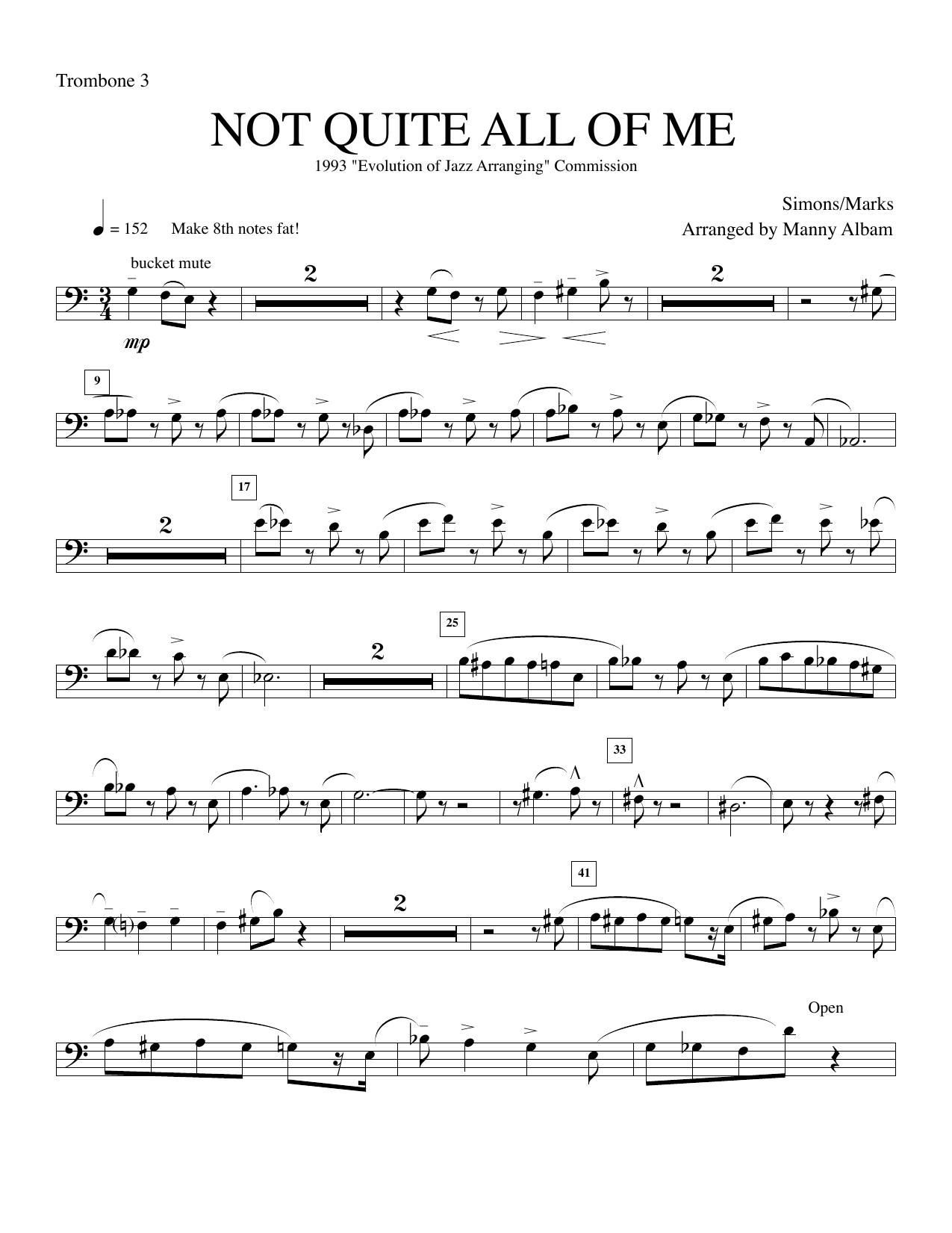
11. Trombone 3. pdf (M.Albam)
Composed by Simons/Marks
Arranged by Manny Albam
- Ensemble: Small Ensemble
- Style: Jazz Standard
- Pages: 4
- Instruments (1): Trombone 3
- Difficulty: easy
- Content: Individual Parts
- Format: PDF Download (Instant)
- Price: $12.99
"All of Me," composed by Gerald Marks and Seymour Simons in 1931, stands as a quintessential jazz standard, deeply rooted in the Great American Songbook. Originally a popular song, it quickly transcended its Tin Pan Alley origins to become a cornerstone of the jazz repertoire, widely known, performed, and recorded by countless jazz musicians. Its enduring appeal lies in its memorable melody, which artfully balances moments of emotional despair with jubilant high notes, and its relatively straightforward yet rich harmonic structure, primarily in B-flat major (though often performed in C major). This harmonic flexibility, featuring common ii-V-I progressions, makes it an ideal vehicle for improvisation, a hallmark of jazz. First brought to public attention through a radio broadcast by vaudeville performer Belle Baker, and later popularized by recordings from Paul Whiteman and Louis Armstrong in 1931-32, "All of Me" has been recorded over 2,000 times, with iconic versions by Billie Holiday, Frank Sinatra, and Sarah Vaughan further cementing its status. In 2000, it received the Towering Song Award from the Songwriters Hall of Fame, a testament to its lasting cultural and musical significance. Manny Albam's arrangement of this timeless standard for small ensemble showcases his distinctive approach to jazz writing. Albam, a highly respected arranger, composer, and educator known for his "taut and witty writing with a flair for distinctive shadings," typically infused his arrangements with sophisticated harmonies and thoughtful voicings. In this particular four-page arrangement, musicians can anticipate Albam's characteristic use of extended harmonies and nuanced counterpoint, even within a small ensemble setting, elevating the original's melodic and harmonic content. His arrangements often feature a bebop-oriented style, favoring subtlety over flash, and this treatment of "All of Me" is likely to reflect that, providing a fresh, intelligent perspective on a familiar tune. The arrangement is designed for a medium swing tempo, allowing for both lyrical expression and rhythmic drive. The melody is likely carried initially by a lead voice, with subsequent sections featuring intricate soli passages that highlight Albam's masterful voicings. While specific solo sections are not detailed, the nature of a jazz standard arrangement by Albam strongly suggests opportunities for improvisation, likely over the tune's accessible chord changes. Technical challenges may include precise ensemble articulation in soli sections, navigating extended harmonies, and maintaining a consistent, authentic swing feel throughout. The rewarding aspect of performing this arrangement lies in its intelligent reinterpretation of a beloved standard, offering musicians the chance to engage with a piece that is both historically rich and musically stimulating. This makes it particularly suitable for advanced high school, college, community, and professional jazz ensembles seeking to explore sophisticated small group repertoire. This arrangement of "All of Me" thrives on a medium swing feel, ideally around a tempo of quarter note = 120-130 BPM, maintaining a relaxed yet forward momentum. Conductors should emphasize a light, buoyant swing eighth-note interpretation, avoiding a rigid, straight feel. Key technical challenges include achieving precise balance and blend within the small ensemble, particularly during Albam's signature soli sections where intricate voicings demand careful listening and intonation. Musicians should pay close attention to dynamic contrasts and articulations to bring out the witty character inherent in Albam's writing. While no specific special techniques like plunger mutes are indicated, expressive use of dynamics, subtle vibrato, and controlled releases will enhance the musicality. Rehearsal time should be dedicated to isolating and perfecting the harmonic nuances of the voicings, ensuring each voice contributes to the overall rich texture. Encourage soloists to engage deeply with the harmonic progression, utilizing melodic development that builds upon Albam's sophisticated foundation. Q: What instruments/parts are included in this arrangement? A: This is a small ensemble arrangement, typically implying a flexible instrumentation such as a rhythm section (piano, bass, drums) and a few melodic instruments (e.g., trumpet, saxophone, trombone). The specific file "11. Trombone 3. pdf" indicates that a dedicated third trombone part is included, suggesting a brass-heavy small group or a larger ensemble where this part is extracted. Q: What is the difficulty level of this arrangement? A: Given Manny Albam's reputation for sophisticated writing, this arrangement is suitable for advanced high school, college, community, and professional jazz ensembles. It requires proficient instrumental technique, strong sight-reading skills, and an understanding of jazz harmony and improvisation. Q: What is the musical style and historical context of "All of Me"? A: "All of Me" is a classic jazz standard, originally composed in 1931 by Gerald Marks and Seymour Simons. It emerged from the Tin Pan Alley era and quickly became a staple in the jazz repertoire due to its memorable melody and adaptable harmonic structure, representing the swing and early bebop eras of jazz. Q: What makes Manny Albam's arrangement of "All of Me" unique? A: Manny Albam is known for his intelligent and witty arrangements, characterized by sophisticated voicings, extended harmonies, and a bebop-oriented style. This arrangement offers a fresh, nuanced interpretation of the standard, providing a rewarding challenge for musicians seeking to explore a classic tune through the lens of a master arranger. Q: What is the typical performance duration or tempo for this piece? A: This arrangement is intended to be performed at a medium swing tempo, generally around 120-130 beats per minute. The overall performance duration will depend on the number and length of improvised solos taken.
Questions and answers
- What is included in the 11. Trombone 3. pdf (M.Albam) PDF?
- The verified current file contains individual parts across 4 pages.
- How many instruments or parts are listed for 11. Trombone 3. pdf (M.Albam)?
- The verified instrumentation list contains 1 entries for this Small Ensemble arrangement.
- Who is credited for 11. Trombone 3. pdf (M.Albam)?
- Composer: Simons/Marks. Arranger: Manny Albam.
- What difficulty is listed for 11. Trombone 3. pdf (M.Albam)?
- The verified difficulty level is easy.
- What style is listed for 11. Trombone 3. pdf (M.Albam)?
- The catalog lists the style as Jazz Standard.
- Can I preview 11. Trombone 3. pdf (M.Albam) before buying?
- Yes. The product page provides a preview generated from the current PDF file.
- How is 11. Trombone 3. pdf (M.Albam) delivered?
- After successful payment, the digital PDF is made available for download. The displayed price is $12.99.
Musicians Also Search For
11. Trombone 3. pdf Manny Albam PDF • 11. Trombone 3. pdf Manny Albam sheet music • 11. Trombone 3. pdf arranged by Manny Albam • Manny Albam small ensemble charts • Manny Albam jazz arrangements PDF • 11. Trombone 3. pdf Simons/Marks sheet music • 11. Trombone 3. pdf Simons/Marks small ensemble arrangements • Simons/Marks small ensemble charts • 11. Trombone 3. pdf small ensemble arrangements • 11. Trombone 3. pdf small ensemble PDF download • 11. Trombone 3. pdf jazz sheet music • small ensemble sheet music download • 11. Trombone 3. pdf individual parts download • 11. Trombone 3. pdf sheet music PDF • 11. Trombone 3. pdf Jazz Standard charts • Jazz Standard small ensemble arrangements • buy 11. Trombone 3. pdf sheet music • download 11. Trombone 3. pdf PDF • 11. Trombone 3. pdf jazz charts • best Manny Albam small ensemble arrangements • Simons/Marks arranged by Manny Albam • 11. Trombone 3. pdf printable sheet music • small ensemble repertoire PDF